
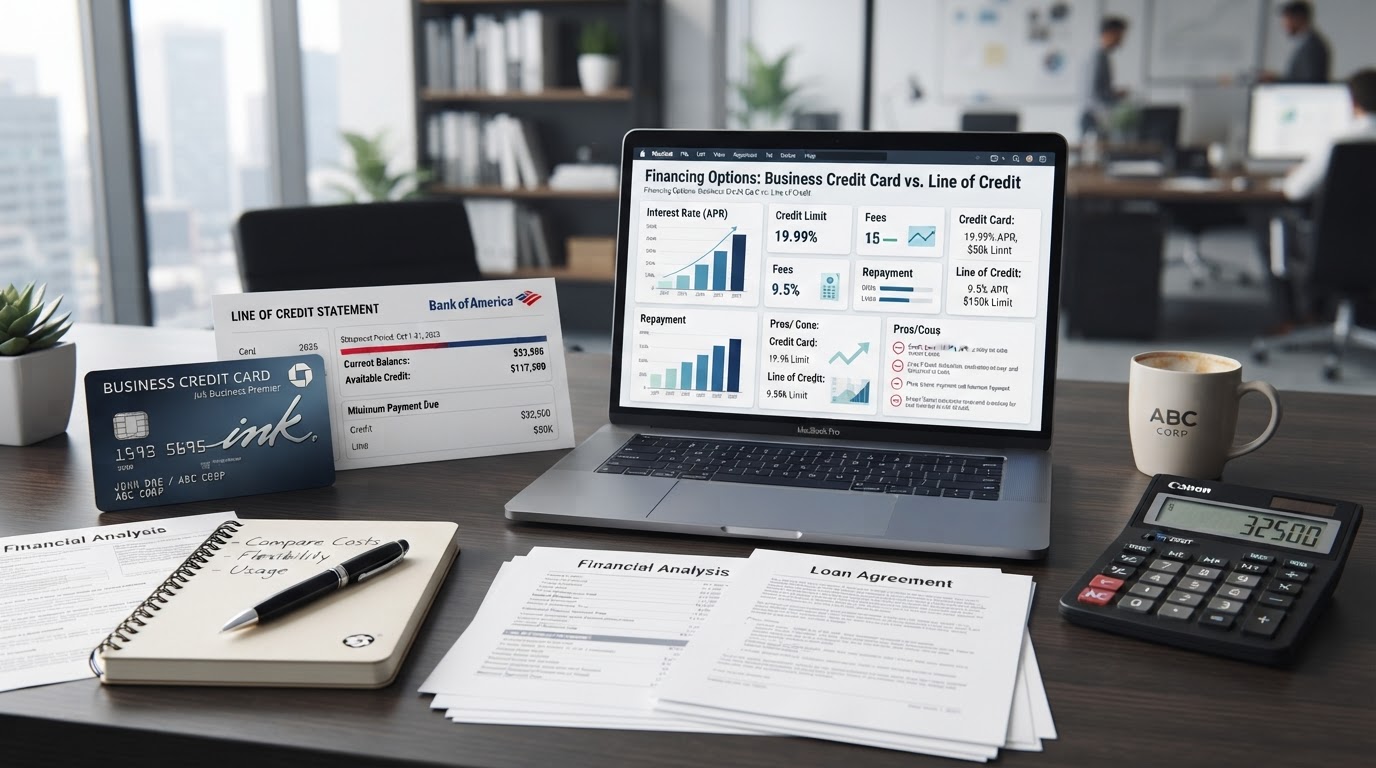
When a business owner needs flexible, on-demand capital, two products almost always come up: a business credit card and a business line of credit. Both are revolving — you draw what you need, repay it, and draw again. Both charge interest only on what you use. And both can sit unused at no cost until the moment a gap appears. At ASAP Capital Solutions, Damon and Ashley Boswell see owners treat these two products as interchangeable all the time, and that assumption is where expensive mistakes begin. They are not the same tool. They share a family resemblance, but the cost structure, the qualification bar, the repayment behavior, and the risk profile are meaningfully different.
In this guide, Damon and Ashley Boswell break down exactly how a business credit card and a business line of credit compare, what each one costs, who qualifies for each, and how to choose the one that fits your business rather than the one a provider happens to be pitching.
The Shared Foundation: Revolving Capital
Both products are built on the same premise. As Bank of America explains, a business line of credit is revolving, like a credit card — interest begins to accumulate once you draw funds, and the amount you pay (except for interest) is again available to be borrowed as you pay down your balance. A business credit card works the same way: you carry a balance, pay it down, and the available credit restores. That shared structure is why the two are so often confused. Both give you a pool of capital you can tap on demand rather than a lump sum you must repay on a fixed schedule.
Ashley Boswell describes the appeal simply: both products give a business a financial safety net it controls. You do not pay for capital you are not using. You only pay for what you draw, and you can reuse the credit as you repay it. Damon Boswell adds that this revolving structure is what makes both products superior to a lump-sum loan for ongoing, unpredictable, or seasonal needs — but the similarities end there, and the differences are where the real decision lives.
Cost: Interest Rates and How They Accrue
The cost difference between the two is significant and often misunderstood. A business line of credit typically carries a lower interest rate than a business credit card. As LendingTree's 2026 data shows, lines of credit from traditional banks run fixed rates around 7.20% and variable rates from 7.80% to 8.10%, while online lenders range widely. Business credit cards, by contrast, routinely charge 18% to 25% or higher once any promotional period ends. That gap is the single most important financial distinction between the two products.
Damon Boswell is direct about what this means: a business that carries a balance on a credit card at 22% is paying roughly three times the cost of a line of credit at 8%. Over a year, a $50,000 balance at 22% costs over $11,000 in interest alone — money that a line of credit would have cost roughly $4,000. Ashley Boswell adds that the accrual method differs too. A line of credit charges interest only on the drawn balance for the period it is outstanding, and repaying it reduces the cost immediately. A credit card compounds daily, and because most business cards require a personal guarantee, the owner is personally responsible for the balance. The credit card's rewards and convenience are real, but they are not free — they are funded by the higher interest rate the owner pays the moment a balance is carried.
The 0% APR Window: The Credit Card's Real Advantage
Where the business credit card gains ground is its 0% introductory APR offer. As Brex explains, many business credit cards offer interest-free financing for 6 to 18 months, and stacking multiple cards can extend that runway further. During that promotional window, a credit card is genuinely cheaper than a line of credit — it is free capital, if the balance is paid down before the window closes. That is the entire premise of 0% credit card stacking, which Damon and Ashley Boswell cover in depth in their dedicated guide.
Damon Boswell frames the comparison honestly: if you can repay the balance within the 0% window, a business credit card is the lowest-cost flexible capital available — lower than any line of credit. If you cannot, the rate jumps to 18% to 25% or higher, and the credit card immediately becomes the most expensive option on the table. Ashley Boswell's rule is to treat the 0% window as a deadline, not a feature. A line of credit's rate is stable and predictable from day one. A credit card's rate is a teaser that expires. The right choice depends entirely on whether your repayment timeline fits inside that window.
Qualification: Credit, Revenue, and Guarantees
Qualification differs meaningfully between the two. A business line of credit from a bank or reputable online lender typically requires stronger business financials — consistent revenue, time in business, and a healthy credit profile — because the lender is underwriting the business directly. Bank of America notes that lines of credit are subject to credit review and annual renewal, and that for larger lines a blanket lien or certificate of deposit may be required as collateral. The qualification bar is higher, but so are the terms.
A business credit card is more accessible. Brex notes that most business credit cards require a personal guarantee and good personal credit, typically a score in the 680 to 700 range or higher. The card issuer evaluates the owner's personal credit more than the business's financials, which is why startups and newer businesses that cannot yet qualify for a line of credit can often access a business credit card. Ashley Boswell adds that this accessibility is the credit card's greatest strength — it opens the door for businesses that a line of credit would turn away. Damon Boswell cautions that the trade-off is the personal guarantee: the owner is personally on the hook for every card in the stack, and a single missed payment can damage the personal credit that made the whole strategy possible.
Rewards, Perks, and the Hidden Math
Business credit cards offer something a line of credit does not: rewards. Cash back, travel points, sign-up bonuses, and purchase protections are genuine benefits that a line of credit cannot match. Fund&Grow notes that many business credit cards offer welcome bonuses and rewards programs that add value beyond the credit itself. For a business that charges significant expenses and pays the balance in full each month, those rewards are essentially free money.
Damon and Ashley Boswell are careful to separate the reward from the trap. The rewards only pay off when the balance is paid in full — the moment a balance is carried, the interest charge dwarfs the reward value. A 2% cash-back reward on a $10,000 spend is $200. A month of interest on a $10,000 balance at 22% is roughly $183. The two nearly cancel out, and the moment the balance extends beyond a single month, the interest pulls decisively ahead. Ashley Boswell's guidance is to use a business credit card for rewards and short-term float that is repaid within the billing cycle, and to use a line of credit for any balance that will extend beyond 30 days. Mixing the two up is how owners turn a rewards strategy into an expensive debt.
Repayment Behavior and Cash Flow Impact
The repayment structures shape how each product affects cash flow. A business line of credit offers flexible repayment — you repay what you have drawn on a schedule that can align with your revenue, and Fora Financial notes that you can repay as cash comes in and redraw as needed. That flexibility is invaluable for businesses with variable or seasonal revenue, because the repayment flexes with the cash flow rather than demanding a fixed outflow.
A business credit card requires a minimum monthly payment — typically 1% to 3% of the balance — but carries the risk of compounding interest if the full balance is not paid. Damon Boswell notes that the minimum payment structure is a trap for undisciplined owners: paying the minimum keeps the account current but allows interest to compound, extending the repayment timeline and inflating the total cost dramatically. A line of credit's repayment is more structured and typically amortizes, meaning each payment reduces the principal. Ashley Boswell adds that for a business that needs to carry a balance for months rather than weeks, the line of credit's amortizing structure is almost always the healthier choice for long-term cash flow.
Credit Reporting and Future Borrowing Power
An often-overlooked difference is how each product affects the owner's credit profile. As StackEasy explains, most major business credit card issuers — Chase, Amex, Bank of America — do not report balance or utilization to the owner's personal credit file unless the account goes delinquent. That means a business can carry a large 0% balance on those cards without moving personal credit utilization. A business line of credit, depending on the lender, may report to business credit bureaus and, in some cases, to personal credit.
Damon Boswell adds a critical nuance: that non-reporting rule is issuer-specific, not universal. Some issuers report business card activity to personal credit even when paid on time, so the owner must verify the policy before assuming a large balance is invisible to personal credit. Ashley Boswell notes that both products, used responsibly, can build business credit and position the business for better terms on future financing. Bank of America confirms that maintaining a line of credit in good standing may help build business credit and improve terms on future loans. The key is consistent, on-time repayment on whichever product the business uses.
When Each Product Wins
Damon and Ashley Boswell have a clear framework for matching the product to the situation. A business credit card wins when the owner has strong personal credit, the need is short-term and repayable within a billing cycle or a 0% promotional window, rewards add genuine value, and the business cannot yet qualify for a line of credit. It is the entry-level flexible capital tool — accessible, rewarding when used right, and dangerous when a balance is carried beyond the promotional period.
A business line of credit wins when the business has the revenue and time in business to qualify, the need is ongoing or recurring, balances will extend beyond 30 days, and the owner wants the lowest stable cost for revolving capital. It is the mature, cost-efficient tool — harder to access but dramatically cheaper for any balance that is not repaid immediately. Damon Boswell adds that many established businesses use both: a credit card for rewards and short-term float, and a line of credit for any balance that will carry beyond the billing cycle. The two complement each other when each is matched to its purpose.
The Risks Every Owner Must Manage
Both products carry risks, and Damon and Ashley Boswell are candid about each. The business credit card's primary risk is the rate jump after the promotional period. Brex warns that missing a payment or failing to manage multiple cards properly can trigger expensive interest charges that quickly spiral, and penalty APRs can jump to 29.99%. The personal guarantee means the owner's personal credit and assets are on the line. The line of credit's primary risk is overextension — because the credit is available and reusable, an undisciplined business can draw repeatedly and accumulate a balance that, even at a lower rate, becomes difficult to service.
Damon Boswell's cautions are consistent across both products. Never carry a credit card balance beyond the 0% window without a concrete repayment plan. Never draw on a line of credit for expenses that produce no return. Never miss a payment on either product, because a single missed payment can damage the personal credit that underpins both. Ashley Boswell adds the most important rule: never stack either product blindly. Multiple credit cards, multiple lines of credit, or a combination of both, all drawn simultaneously, create a debt load that compounds faster than most businesses can absorb. The revolving structure is an advantage only when the discipline to repay matches the freedom to draw.
Is a Business Credit Card or Line of Credit Right for You?
Damon Boswell's readiness test is direct: Is your need short-term and repayable within a billing cycle or a 0% promotional window? Do you value rewards and have the discipline to pay balances in full? Is your personal credit strong but your business too new to qualify for a line of credit? If so, a business credit card is your tool. Does your business have consistent revenue, sufficient time in business, and a need for revolving capital that will extend beyond 30 days? Do you want the lowest stable cost for ongoing flexible access? If so, a business line of credit is your tool. And if both descriptions fit different needs in your business, the answer may be both — each matched to its specific purpose.
If you are unsure where your business stands, that is exactly what our AI Funding Match Calculator is built to clarify. The calculator weighs your revenue, credit, timeline, and goals, and Damon and Ashley Boswell review every result personally. On a short phone call — no Zoom required — we will help you determine whether a business credit card, a line of credit, or a combination is the right fit for your flexible capital needs.
The Bottom Line
A business credit card and a business line of credit are both revolving, flexible capital tools, but they serve different businesses and different needs. The credit card is accessible, rewarding, and interest-free during a promotional window — ideal for short-term float and businesses that cannot yet qualify for a line. The line of credit is cheaper, more stable, and better suited for balances that extend beyond a billing cycle. Damon and Ashley Boswell have helped owners across the United States, Puerto Rico, and Canada choose between them, and the businesses that succeed are the ones that match the product to the repayment timeline rather than defaulting to whichever is easier to obtain.
See which flexible capital fits your business. Complete the AI Funding Match Calculator in under 60 seconds, and Damon and Ashley Boswell will walk through your matches, your cost, and your next step on a quick phone call — so your revolving capital works for you instead of against you.
Damon Boswell and Ashley Boswell
Funding specialists at ASAP Capital Solutions, helping business owners find the right capital across the United States, Puerto Rico, and Canada.
Find Your Funding Match in 60 Seconds
Complete the AI Funding Match Calculator and Damon and Ashley Boswell will review your matches on a quick phone call.
Get My Funding Match

