
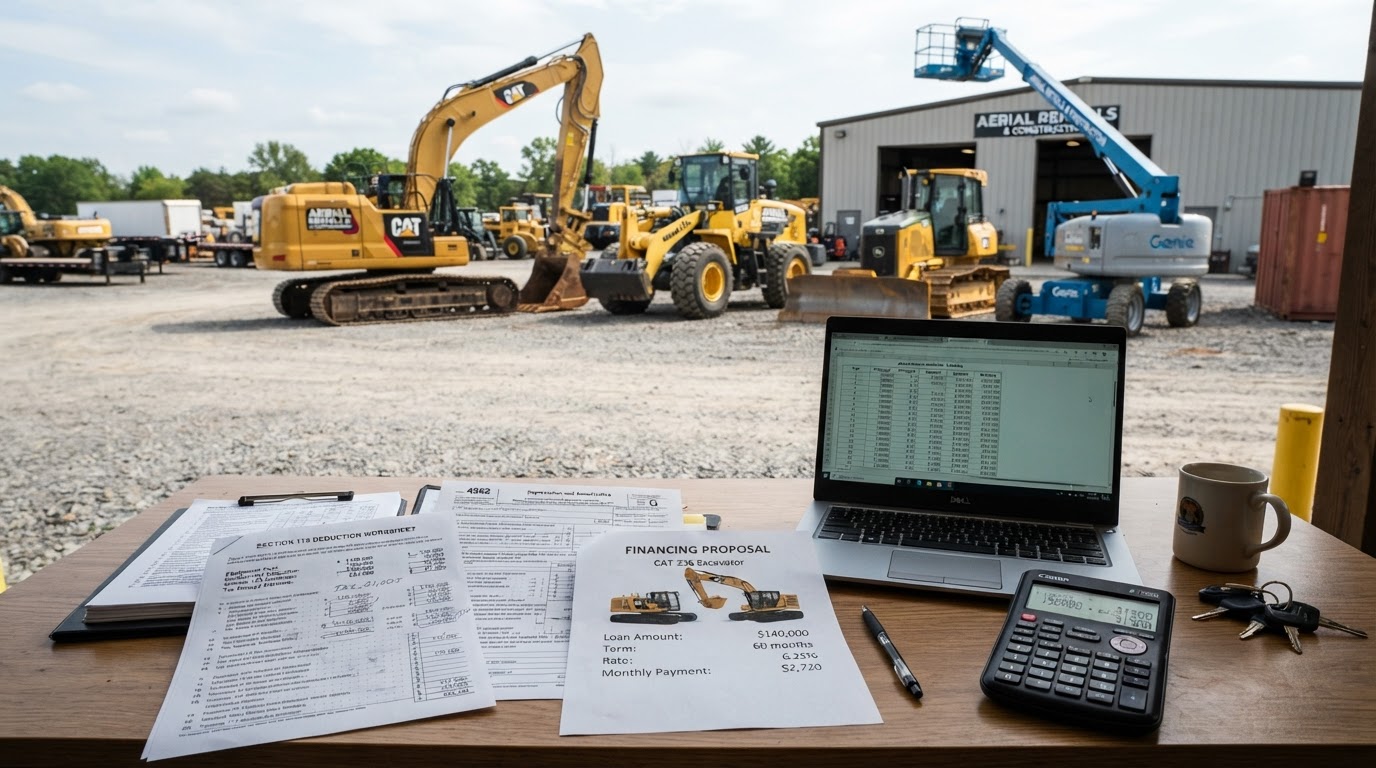
There is a piece of funding math that surprises nearly every business owner the first time they see it: financing a piece of equipment can leave your bank account healthier at the end of the year than paying cash for the same equipment. That is not a typo. It is the result of Section 179, the tax code provision that lets a business deduct the full purchase price of qualifying equipment in the year it is placed in service — even when that equipment is financed rather than purchased outright. At ASAP Capital Solutions, Damon and Ashley Boswell walk owners through this calculation constantly, and the owners who understand it make fundamentally different equipment decisions than the ones who do not.
In this guide, Damon and Ashley Boswell break down how equipment financing works, what Section 179 allows in 2026, how bonus depreciation interacts with it, what qualifies, and how to use financing to capture the tax benefit while preserving the cash flow the business needs to operate.
What Is Equipment Financing?
Equipment financing is a loan or lease structured specifically for the purchase of business equipment — machinery, vehicles, technology, office furniture, and other tangible assets. The equipment itself typically serves as the collateral for the financing, which makes it more accessible than unsecured loans because the lender's risk is backed by a tangible, resalable asset. As Lendio notes, equipment financing is available to startups and businesses with limited credit history because the equipment secures the loan, and it can fund needs that revenue-based products cannot.
Ashley Boswell describes the appeal simply: equipment financing lets a business acquire the machinery it needs to grow without draining the cash it needs to operate. Instead of paying $75,000 upfront for a piece of equipment, the business pays a manageable monthly payment over several years while the equipment generates revenue from day one. Damon Boswell adds that because the equipment secures the loan, the qualification bar is lower than an unsecured term loan — the lender cares more about the value of the equipment and the business's ability to make the payments than about a pristine credit profile.
Section 179: The Deduction That Changes the Math
Section 179 is the provision that transforms equipment financing from a cash-flow tool into a tax strategy. As the IRS code allows, and as Stearns Bank explains, Section 179 lets businesses deduct the full purchase price of qualifying equipment purchased and placed in service during the tax year. The deduction is not limited to cash purchases — financed equipment qualifies as long as the business is treated as the tax owner of the equipment, which is what Section 179 Qualified Financing describes.
Damon and Ashley Boswell walk every owner through the math that makes this so powerful. A business that finances $75,000 of equipment and places it in service during the tax year can deduct the full $75,000 under Section 179, even though it has only made a few months of payments. At a 35% tax rate, that deduction delivers roughly $26,250 in tax savings — money that flows back to the business in the form of a reduced tax bill. As Section179.org puts it, in many cases the tax savings from the deduction will actually leave your bank account healthier than if you had paid cash. The business keeps its cash, finances the equipment, and still captures the full deduction. That is the core insight most owners miss.
The 2026 Limits: What You Can Deduct
The 2026 numbers are significant. As U.S. Bank outlines, the One Big Beautiful Bill Act of 2025 made major changes to both Section 179 and bonus depreciation that took effect in 2025 and continue into 2026. For 2026, the Section 179 maximum deduction is $2,560,000, up from $2,500,000 in 2025, and the deduction begins to phase out for businesses that spend more than $6,650,000 on equipment in the year. The deduction applies to both new and used qualifying equipment, which broadens its usefulness considerably.
Damon Boswell frames what this means: a business can deduct up to $2.56 million of equipment purchases in a single tax year, financed or cash, new or used. That is a substantial incentive to invest in equipment, and it is why the timing of equipment purchases matters so much. Equipment placed in service by December 31 qualifies for that year's deduction, so an equipment purchase timed for the tax year can deliver a deduction that reduces the current year's tax bill rather than spreading the benefit over years of depreciation. Ashley Boswell adds that the phase-out threshold means very large equipment spend can reduce the per-dollar benefit, but for the vast majority of small and mid-sized businesses, the full deduction is available.
Bonus Depreciation: The Companion to Section 179
Section 179 is not the only deduction available, and Damon and Ashley Boswell are careful to explain how bonus depreciation interacts with it. As U.S. Bank notes, the 2026 bonus depreciation percentage is 100% on both new and used qualified business property, restored to the full level by the 2025 legislation after several years of declining percentages. Bonus depreciation works in conjunction with Section 179 — the business applies Section 179 first to reduce taxable income, then applies 100% bonus depreciation to the remainder of the asset's eligible cost.
Damon Boswell explains the practical effect: a business that exceeds the Section 179 deduction limit, or that wants to preserve Section 179 capacity for other purchases, can use bonus depreciation to deduct the remaining cost of the equipment in the first year. The combination means that in 2026, a business can effectively deduct 100% of qualifying equipment purchases in the year they are placed in service. Ashley Boswell stresses that the choice between Section 179 and bonus depreciation, and the order in which they are applied, should be made with a tax professional, because the optimal strategy depends on the business's total equipment spend, taxable income, and future plans. The funding decision and the tax decision are connected, and both should be made deliberately.
What Qualifies for Section 179
The range of qualifying property is broad. As Block Advisors outlines, most types of business equipment purchased and placed in service during the tax year qualify — machinery, vehicles, software, office equipment, furniture, and building improvements among them. The equipment must be used more than 50% for business, and the deduction is pro-rated if business use is below 100%. The equipment must be placed in service — meaning delivered and ready for its intended business use — during the tax year, not merely ordered or paid for.
Ashley Boswell's guidance is to confirm qualification before assuming the deduction. Most tangible business equipment qualifies, but there are nuances — software must be off-the-shelf, vehicles have specific limits, and real estate improvements have their own rules. Damon Boswell adds that the placed-in-service requirement is the one that catches owners most often. An equipment purchase ordered in December but not delivered and operational until January does not qualify for the prior year's deduction, regardless of when it was paid for. Timing the delivery and installation to fall within the tax year is essential to capturing the benefit.
Financing vs. Cash: The Full Comparison
This is where Damon and Ashley Boswell spend the most time, because the comparison reveals why financing can be superior to cash. A business that pays $75,000 cash for equipment has the equipment and $75,000 less in the bank, but it captures the full Section 179 deduction. A business that finances the same $75,000 equipment has the equipment, keeps most of its $75,000 in cash, makes monthly payments over several years, and captures the same full Section 179 deduction in the year the equipment is placed in service.
Damon Boswell walks through the year-one outcome. The financing business deducts the full $75,000, saves roughly $26,250 in taxes at a 35% rate, and has preserved roughly $75,000 in cash (minus any down payment) to deploy elsewhere in the business. The cash business deducts the same $75,000 and saves the same $26,250, but its cash is gone. Ashley Boswell adds that the financing business also keeps its cash working — earning a return, covering operations, or serving as a buffer — while the equipment generates revenue from day one. The combination of the deduction, the preserved cash, and the immediate revenue from the equipment is what makes financing so often the superior choice, even for businesses that could afford to pay cash.
Equipment Financing vs. Equipment Leasing
Equipment leasing is the alternative to financing, and the distinction matters for the tax treatment. A true lease, where the lender retains ownership of the equipment, does not qualify for Section 179 in the same way, because the business is not the tax owner of the equipment. A financed purchase or a capital lease, where the business is treated as the owner for tax purposes, does qualify. As Section179.org explains, Section 179 Qualified Financing is structured so the business is treated as the purchaser and tax owner, which is what allows the deduction.
Damon Boswell's guidance is to clarify the structure before signing. If the goal is the Section 179 deduction, the financing must be structured as a purchase or capital lease, not a true operating lease. Ashley Boswell adds that leasing has its own advantages — lower upfront cost, flexibility to upgrade, and off-balance-sheet treatment in some cases — but it does not deliver the same first-year deduction. The choice between financing and leasing depends on whether the business wants to own the equipment and capture the deduction, or wants the flexibility and lower commitment of a lease. For businesses focused on the tax benefit, financing is almost always the better path.
Qualifying for Equipment Financing
Qualification for equipment financing is more accessible than many owners expect, precisely because the equipment secures the loan. As Lendio notes, equipment financing is available to startups and businesses with limited credit history, because the lender's risk is backed by the asset itself. Lenders typically review the business's credit, time in business, revenue, and the value and condition of the equipment being financed. A down payment of 10% to 20% is common, though some programs require less.
Damon Boswell's preparation guidance is straightforward: know the equipment you need and its cost, have your business financials and bank statements ready, and confirm that the equipment qualifies for Section 179 if the tax benefit is part of your decision. Ashley Boswell adds that because the equipment secures the loan, the rate is typically lower than an unsecured loan of the same size, and the term is often matched to the equipment's useful life — so a piece of machinery expected to last seven years might be financed over five to seven years, aligning the payments with the revenue the equipment generates.
Timing the Purchase for the Tax Year
Because Section 179 requires the equipment to be placed in service during the tax year, timing the purchase is a strategic decision. Damon and Ashley Boswell see owners rush equipment purchases in the fourth quarter specifically to capture the current year's deduction, and that strategy is legitimate — but it requires the equipment to be delivered and operational by December 31, not merely ordered. An order placed in December that delivers in January pushes the deduction to the following tax year.
Damon Boswell's guidance is to work backward from the deadline. If the equipment takes six weeks to deliver and install, the order must be placed by mid-November to ensure it is in service by year-end. Ashley Boswell adds that the financing should be arranged before the order is placed, so the purchase is not delayed by the funding process. The combination of arranged financing, a confirmed delivery timeline, and a clear understanding of the placed-in-service requirement is what allows a business to capture the deduction in the intended tax year.
Is Equipment Financing Right for You?
Damon Boswell's readiness test is direct: Do you need equipment that will generate revenue or reduce costs over its useful life? Does the equipment qualify for Section 179, and will it be placed in service during the tax year you want the deduction? Can you afford the monthly payment from the revenue or savings the equipment generates? Would preserving your cash for operations and growth serve the business better than spending it on the equipment? If you can answer yes to these, equipment financing — combined with Section 179 — is one of the most powerful funding and tax strategies available to your business.
If you are unsure where your business stands, that is exactly what our AI Funding Match Calculator is built to clarify. The calculator weighs your revenue, credit, timeline, and goals, and Damon and Ashley Boswell review every result personally. On a short phone call — no Zoom required — we will help you determine whether equipment financing fits your need, what the Section 179 benefit could mean for your tax year, and how to structure the purchase to capture both the equipment and the deduction.
The Bottom Line
Equipment financing is not just a way to buy machinery — it is a way to acquire productive assets, capture a full-year tax deduction under Section 179, and preserve the cash the business needs to operate and grow. The 2026 limits of a $2.56 million Section 179 deduction and 100% bonus depreciation make this one of the most generous tax incentives in the code, and financing the equipment rather than paying cash allows the business to capture the deduction while keeping its capital working elsewhere. Damon and Ashley Boswell have helped owners across the United States, Puerto Rico, and Canada use equipment financing as both a funding and a tax strategy, and the businesses that succeed are the ones that understand the math, time the purchase for the tax year, and structure the financing to qualify for the deduction.
See whether equipment financing fits your business. Complete the AI Funding Match Calculator in under 60 seconds, and Damon and Ashley Boswell will walk through your equipment need, your Section 179 benefit, and your next step on a quick phone call — so you get the machinery, the deduction, and the cash flow all at once.
Damon Boswell and Ashley Boswell
Funding specialists at ASAP Capital Solutions, helping business owners find the right capital across the United States, Puerto Rico, and Canada.
Find Your Funding Match in 60 Seconds
Complete the AI Funding Match Calculator and Damon and Ashley Boswell will review your matches on a quick phone call.
Get My Funding Match

