
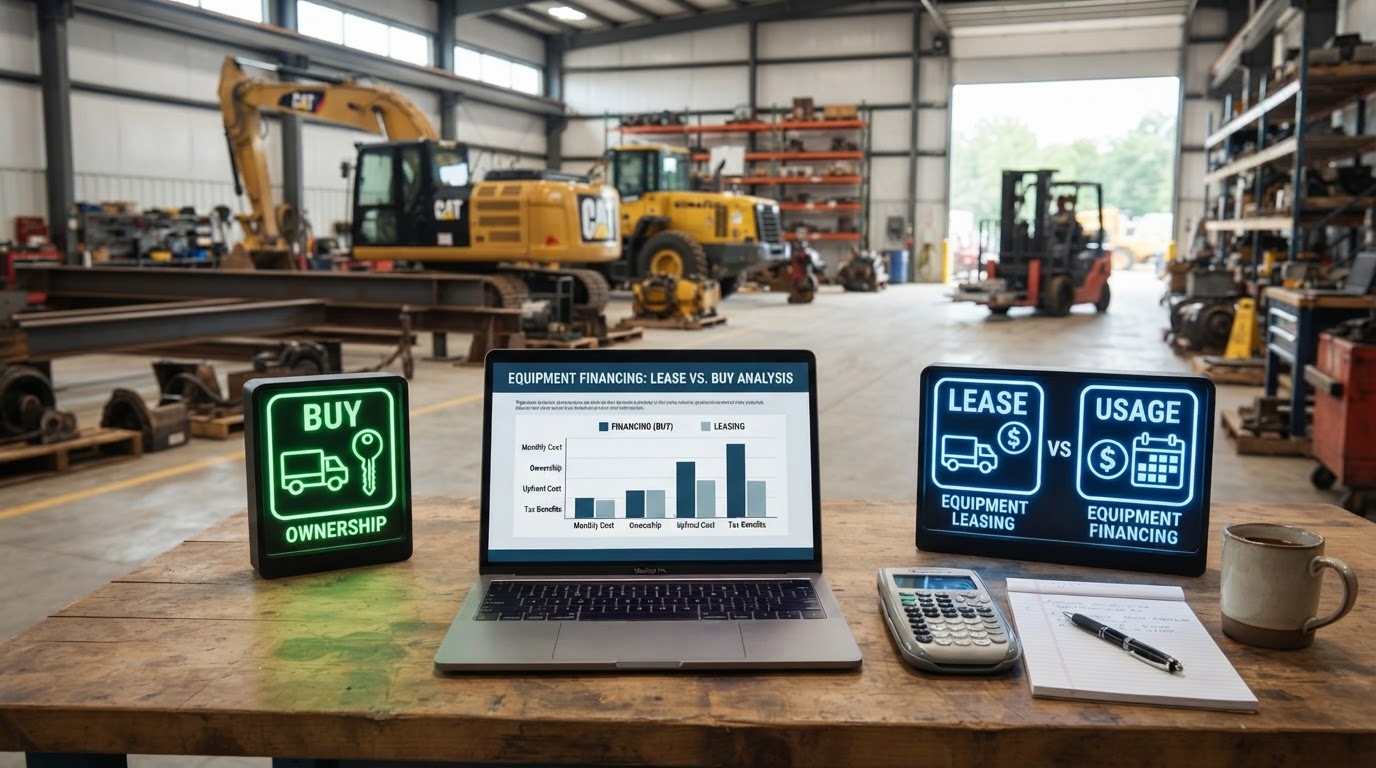
It is rare to find a business that does not need some kind of equipment to operate, which means starting or expanding almost always involves acquiring machinery, vehicles, technology, or fixtures. And for most owners, paying for that equipment in cash is not the right move — it drains working capital that the business needs for payroll, inventory, and the unexpected. That is why nearly every equipment conversation at ASAP Capital Solutions comes down to the same fork in the road that Damon and Ashley Boswell walk owners through: should you lease the equipment or finance its purchase? Both put the asset in your hands without an upfront cash outlay, but the long-term outcomes are very different, and choosing the wrong one can cost a business tens of thousands of dollars over the life of the asset.
In this guide, Damon and Ashley Boswell break down exactly how equipment leasing and equipment financing differ in 2026 — who owns the asset, what it costs over time, how the tax treatment compares, where the hidden risks live, and how to decide which path fits a specific piece of equipment and a specific business.
The Core Difference: Ownership
Everything flows from one distinction. As PNC explains in its guide for business owners, at a fundamental level, equipment leasing and financing differ in ownership. Leasing involves paying for the right to use the equipment over a set period, while financing involves borrowing funds to purchase the asset. Although lease agreements may sometimes convert to purchase agreements, the end result of a lease term is not ownership — the lender retains ownership. In financing, the business pays for the equipment on a set schedule, and at the end, owns the equipment.
Ashley Boswell translates that for every owner: when you finance, you are buying the equipment over time and it becomes yours. When you lease, you are renting it, and at the end of the term you either return it, renew the lease, or — in some agreements — buy it. That single difference in ownership shapes the cost, the tax treatment, the maintenance responsibility, and the flexibility, which is why Damon and Ashley Boswell never let an owner choose between the two without first understanding that distinction.
Upfront Costs and Monthly Payments
The two paths differ sharply at the start. As PNC notes, equipment financing often comes with higher upfront costs because the lender is determining whether the business can shoulder repayment, while equipment leasing typically comes with lower upfront costs because ultimately the intent is not to purchase. That lower barrier preserves working capital and smooths out the path to acquiring equipment, especially for a new business. Pathward reinforces that leasing may make more sense when a business lacks funds for a down payment, needs equipment for a short-term project, or wants the vendor to handle upkeep and maintenance.
Damon Boswell frames the trade-off in cash-flow terms: leasing keeps cash freer and more flexible for near-term expenses and offers an easier pathway to getting the equipment in the first place, while financing can reduce the total lifetime cost if the equipment remains valuable over the years. Both typically offer fixed, predictable monthly payments, which makes budgeting straightforward either way. The question is not which is cheaper per month — it is which is cheaper over the full useful life of the asset, and that depends entirely on how long the business will use the equipment and whether it retains value.
Cost Over the Life of the Asset
This is where the long-term math matters most, and where Damon and Ashley Boswell spend the most time with owners. Sunflower Bank's analysis is clear: equipment financing provides ownership and potential tax benefits but comes with depreciation risks and higher upfront costs, while equipment leasing offers flexibility, lower initial expenses, and maintenance support but may be more expensive over time and does not result in ownership. The ABC Bank guide adds that the biggest downside of leasing is that a business does not build equity, and leasing can sometimes be more expensive than buying through an equipment loan.
Damon Boswell's rule is simple: if the business will use the equipment for its full useful life, financing almost always costs less in total because the payments end and the business owns an asset. If the business will use the equipment for only a year or two and then move on, leasing avoids paying off a loan on something the business no longer needs. The mistake he sees most often is a business leasing equipment it will use for a decade — paying more in total lease payments than the equipment cost new, and owning nothing at the end. Ashley Boswell adds the reverse mistake: financing equipment that becomes obsolete in eighteen months, leaving the business paying off a loan on machinery it can no longer compete with. Matching the funding structure to the asset's useful life is the single most important decision in the process.
Tax Treatment: Section 179, Depreciation, and Lease Deductions
The tax implications are real and often decisive. The ABC Bank guide explains that when a business buys equipment through an equipment loan, it can make use of depreciation write-offs such as Section 179 tax deductions, which allow a business to deduct the full purchase price of qualifying equipment in the year it is placed in service. With an equipment lease, a business cannot deduct for equipment depreciation, but it can deduct lease payments and interest costs as long as the contract is a genuine lease rather than a conditional sales contract — and if the agreement is a conditional sales contract where the business winds up buying the equipment, depreciation expenses apply instead.
Ashley Boswell is careful to remind every owner that tax outcomes depend on the specific structure of the agreement and the business's own tax situation, so consulting a tax advisor before signing is not optional — it is due diligence. Damon Boswell adds that for a profitable business that can use an immediate deduction, Section 179 on a financed purchase can materially reduce the effective cost of the equipment in year one, which is an advantage leasing simply cannot replicate. For a business that prefers to spread the deduction evenly over time, lease-payment deductions offer smoother, predictable annual tax benefits. The right answer depends on the business's current and projected tax position, not on a general rule of thumb.
Obsolescence Risk and the Technology Question
The pace of change in a business's equipment shapes the lease-versus-finance decision as much as cost does. PNC warns that financing ties working capital to a long-term obligation, and in industries where equipment may undergo massive upgrades or changes in a relatively short period, a business might end up stuck with an older model — and all responsibility for maintenance and repair falls on the company, so sudden downtime is a bigger challenge than it would be under a lease. The ABC Bank guide notes that leases are typically used for equipment that faces rapid obsolescence and needs frequent upgrades to remain competitive, such as IT hardware, specialized medical devices, and cutting-edge software systems.
Damon Boswell's framework is to ask how long the equipment stays competitive, not just how long it physically lasts. A piece of construction equipment may operate reliably for fifteen years, making financing the obvious choice. A server farm or diagnostic imaging system may be state of the art for three years, making a lease that allows an upgrade at term end the smarter move. Ashley Boswell adds that leasing offers greater flexibility to upgrade or swap equipment, while financing ties the business to an asset for its useful life — so the decision is as much about agility as it is about cost. A business in a fast-moving industry that values being on the latest technology should lean toward leasing; a business in a stable industry with long-lived assets should lean toward financing.
Maintenance, Responsibility, and End-of-Term Scenarios
Ownership carries responsibility. As Sunflower Bank explains, in financing the equipment becomes an asset on the balance sheet, potentially increasing business value but also adding maintenance responsibilities, and once the agreement is over the business must maintain, service, and dispose of the equipment on its own. In a lease, ownership typically remains with the lessor, and depending on the agreement the business may have the option to renew the lease or return the asset. Sunflower Bank distinguishes the two lease types: operating leases, which are short-term and where the lessor retains ownership and maintenance responsibilities, and capital leases, which are long-term and often resemble a purchase agreement with the lessee assuming ownership-like responsibilities and possibly an option to buy at the end for a nominal fee.
Ashley Boswell notes that some leases include maintenance and repair services, saving the business additional costs — a meaningful advantage for equipment that requires frequent service or specialized technicians. Damon Boswell adds the cautions from Sunflower Bank: lease agreements may have usage restrictions and penalties for excessive wear and tear or early termination, so reading the fine print is essential. And PNC reminds owners that financing payments come to an end eventually, allowing the business to take advantage of the full value of the equipment, whereas lease payments continue as long as the business uses the leased asset. The end-of-term scenario — own it free and clear, or hand it back — should be decided before the agreement is signed, not discovered at the end.
When a Loan Is the Better Fit
Pathward is clear about when financing wins: when the equipment is critical to daily operations and the business considers it a long-term investment that helps generate revenue. The ABC Bank guide adds that businesses choose financing for equipment that has a long lifespan and will not become obsolete by the time the loan is paid off, and when the business wants to add a tangible asset to its balance sheet that can serve as collateral for other loans. Sunflower Bank notes that using the equipment as collateral can secure lower interest rates than unsecured loans, which is one of the reasons equipment financing is accessible even to businesses that might not qualify for an unsecured term loan.
Damon Boswell's guidance is to finance when the business has consistent cash flow that can manage the higher upfront or ongoing costs, when the equipment will remain essential and reliable for years, and when the time to break even is worth the initial investment. Ashley Boswell adds a strategic point: building a balance sheet of owned, depreciating assets creates collateral that unlocks larger and cheaper funding down the road — a compounding advantage that leasing, by design, never provides.
When Leasing Makes More Sense
Pathward identifies the leasing scenarios: equipment that needs frequent upgrading due to rapid technology changes or evolving project demands, when predictable monthly payments are preferable to large initial investments, when maintenance or end-of-life management is expensive and better left to the lessor, and when projects are short-term or seasonal and the time to make back the initial investment would be longer than the business is comfortable with. The ABC Bank guide adds that leasing preserves working capital and lets the business keep more liquid cash on hand to fund operations, make payroll, and cover unexpected expenses.
Ashley Boswell's favorite leasing case is the seasonal business that needs equipment for a defined window — a construction firm leasing a crane for a single project, a caterer leasing refrigeration for a busy quarter, a startup leasing servers until it can justify a purchase. The equipment serves its purpose and goes back, with no loan to pay off after the need has passed. Damon Boswell adds that leasing may have more lenient credit requirements than financing, making it accessible to a broader range of businesses, which matters for newer operations still building a credit profile. The trade-off is always the same: lower barrier today, higher total cost over a long horizon.
How to Decide: Damon and Ashley Boswell's Framework
Damon and Ashley Boswell reduce the decision to five questions. First, how long will the business use the equipment? Long-lived assets favor financing; short-lived or fast-obsolescing assets favor leasing. Second, does the business need the equipment permanently or for a defined project or season? Permanent needs favor financing; temporary ones favor leasing. Third, can the business use a Section 179 deduction this year, and does that change the effective cost? If so, financing's tax advantage can be decisive. Fourth, is maintenance a burden the business wants to own, or would the business prefer the lessor to handle it? Fifth, does the business value building collateral on the balance sheet for future funding, or preserving maximum cash flexibility today?
Damon Boswell's summary is that there is no universal winner — there is only the right fit for a specific asset in a specific business at a specific moment. Financing for long-lived, essential, collateral-building assets. Leasing for short-term, fast-obsolescing, maintenance-heavy assets. And for businesses that need a mix — a financed fleet of long-lived trucks alongside leased technology that upgrades every two years — the strongest approach is to use both deliberately, each matched to the asset it serves best.
Is Equipment Leasing or Financing Right for You?
Damon Boswell's readiness test is direct: Do you know the full useful life of the equipment you need, both physically and competitively? Have you compared the total cost of financing — including down payment, interest, and maintenance — against the total cost of leasing over the same period? Have you consulted a tax advisor on Section 179 and lease-payment deductions for your specific situation? Does the agreement's end-of-term scenario — owning the asset or returning it — match your plan for the equipment? And have you matched the structure to the asset rather than defaulting to whichever option a single vendor offered? If you can answer yes to these, you are positioned to choose between leasing and financing with confidence.
If you are unsure where your business stands, that is exactly what our AI Funding Match Calculator is built to clarify. The calculator weighs your revenue, credit, timeline, and goals, and Damon and Ashley Boswell review every result personally. On a short phone call — no Zoom required — we will help you determine whether to lease or finance the equipment in front of you, what each path will truly cost, and which structure fits your business.
The Bottom Line
Equipment leasing and equipment financing both put essential machinery, vehicles, and technology in a business's hands without a cash outlay — but they are not interchangeable. Financing delivers ownership, tax benefits, and long-term cost efficiency for assets a business will use for years. Leasing delivers flexibility, lower upfront costs, and protection from obsolescence for assets a business will outgrow or replace quickly. Damon and Ashley Boswell have helped owners across the United States, Puerto Rico, and Canada choose between the two, and the businesses that succeed are the ones that match the funding structure to the useful life of the asset rather than defaulting to whichever option arrived first.
See which path fits your next equipment purchase. Complete the AI Funding Match Calculator in under 60 seconds, and Damon and Ashley Boswell will walk through your options, your costs, and your next step on a quick phone call — so the equipment your business needs arrives on the terms that make the most sense.
Damon Boswell and Ashley Boswell
Funding specialists at ASAP Capital Solutions, helping business owners find the right capital across the United States, Puerto Rico, and Canada.
Find Your Funding Match in 60 Seconds
Complete the AI Funding Match Calculator and Damon and Ashley Boswell will review your matches on a quick phone call.
Get My Funding Match
