
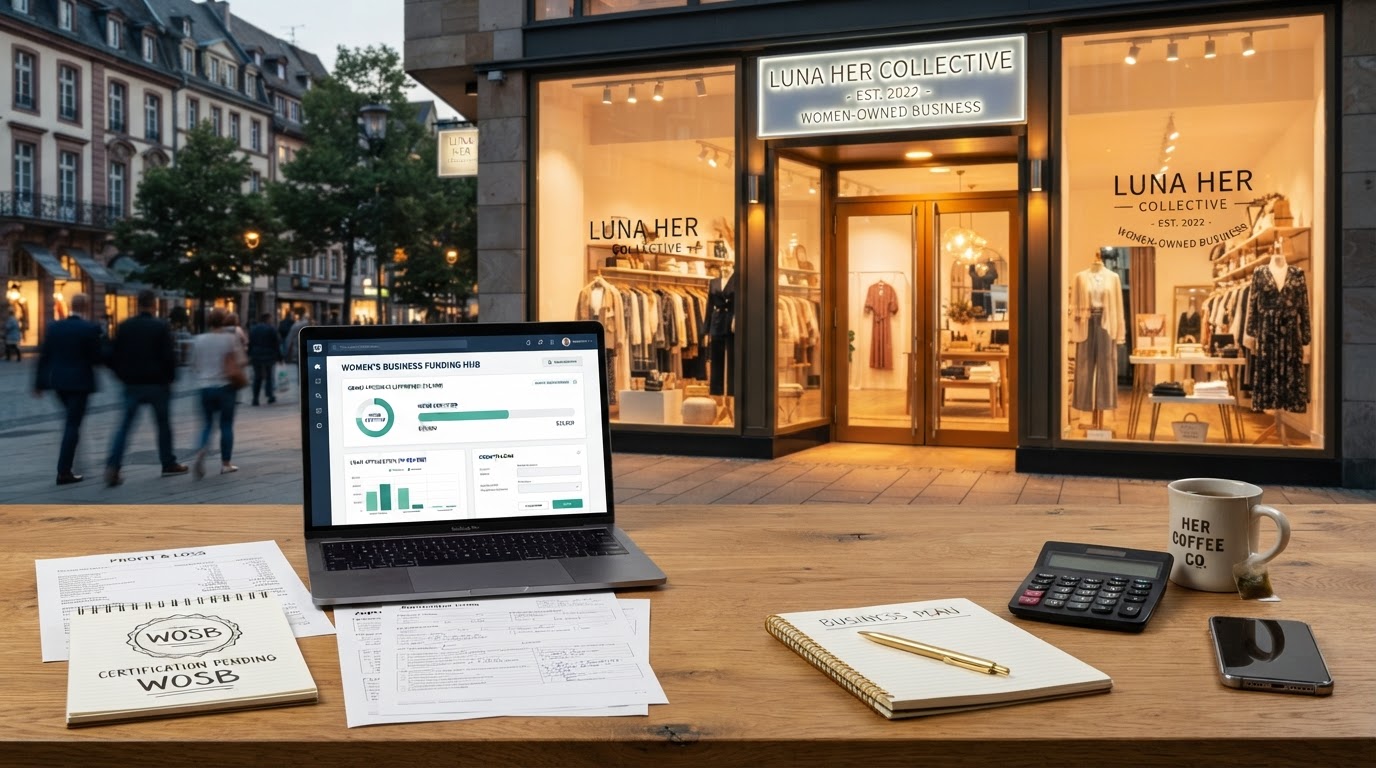
Women are starting businesses at a faster rate than the national average, and the contribution of women-owned businesses to the U.S. economy has grown dramatically over the past decade. Yet the founders Damon and Ashley Boswell speak with every week tell a consistent story: access to capital remains the single most stubborn obstacle standing between a women-owned business and its next stage of growth. The data backs that up. Research has repeatedly shown that women founders are approved for small business loans at lower rates than their male counterparts and frequently receive smaller loan amounts when they are approved. At ASAP Capital Solutions, Damon and Ashley Boswell work directly with women entrepreneurs across the United States, Puerto Rico, and Canada, and their starting point is always the same: the capital exists. The challenge is knowing which doors to knock on, what each one requires, and how to combine them.
In this guide, Damon and Ashley Boswell walk through every realistic funding path available to a women-owned business in 2026 — the SBA loan programs built to serve underserved entrepreneurs, the grants that never have to be repaid, the certifications that unlock federal contracting dollars, the alternative lenders that weigh revenue over credit, and how to layer them into a strategy that fits a specific business at a specific moment.
The Capital Gap Is Real — and It Is Fixable
Before diving into the tools, Damon and Ashley Boswell are candid about the gap because pretending it does not exist does not help anyone. Studies of small business lending have consistently found that women-owned firms are less likely to receive loans than men-owned firms, and that when women do receive funding, the dollar amounts tend to be smaller. The reasons are layered — thinner credit histories, smaller collateral bases, and in some cases simply applying through the wrong channel — but the practical effect is the same: many women-owned businesses start smaller, grow slower, and miss opportunities not because the business is weak but because the capital did not arrive at the right moment.
Damon Boswell frames the solution plainly: you cannot wish the gap away, but you can route around it. Women-owned businesses that succeed in accessing capital are the ones that build a credit profile deliberately, pursue every program designed for them, and match the funding tool to the need rather than defaulting to whatever a single lender offers. Ashley Boswell adds that the single most common mistake she sees is a woman founder applying for a conventional bank loan, being declined, and concluding funding is impossible — when the reality is that the conventional bank was simply the wrong first door. The right first door is almost always a program built to serve businesses like hers.
SBA Loans: The Government-Backed Foundation
The U.S. Small Business Administration is, for many women-owned businesses, the most important resource in the funding landscape. As the SBA explains, its Office of Women's Business Ownership helps women entrepreneurs launch and compete in the marketplace through training and funding opportunities specifically for women, and women-owned small businesses can take advantage of SBA loan programs. The flagship SBA 7(a) loan provides up to $5 million for working capital, equipment, real estate, and business acquisition, with the government guarantee reducing lender risk and enabling the favorable terms and lower down payments that make larger capital accessible.
Ashley Boswell points women founders to the SBA microloan program as well. As Lendio explains, the SBA microloan program provides loans up to $50,000 through nonprofit, community-based intermediary lenders that specialize in supporting underserved entrepreneurs and early-stage businesses, with the average microloan around $13,000 and roughly a quarter of all microloans going to startups. For a woman founder who needs $15,000 to $50,000 to launch or expand and may not yet qualify for a large conventional loan, the microloan is often the realistic first stop. Damon Boswell adds that SBA-approved lenders make all credit decisions and set the terms, so the intermediary matters as much as the program — finding one that serves a founder's geography and industry is the first practical step, and the SBA's Lender Match tool exists precisely to make that connection.
Grants: Capital That Never Has to Be Repaid
Grants are the only funding source that does not require repayment, and for women-owned businesses there are more grant opportunities in 2026 than ever before. NerdWallet's 2026 roundup of small-business grants for women catalogs dozens of options, including private grants like the Amber Grant from WomensNet, which was founded in 1998 and now awards at least $30,000 every month in grant money, with monthly $10,000 grants and year-end $50,000 grants. The Hartford adds that the Amber Grant announces a $10,000 recipient the first week of every month and a $25,000 annual winner every January.
Damon and Ashley Boswell encourage every woman founder to treat grants as a parallel pursuit alongside loans rather than a primary strategy. NerdWallet's 2026 list includes programs like the Fund Her Future Grant offering $45,000 plus $5,000 in services, the EmpowHER Grants offering up to $50,000, the BMO Celebrating Women Grant Program awarding $10,000 to fifteen entrepreneurs, and the Hey Helen Grant providing $10,000 in non-dilutive funding to 100% women-owned businesses generating less than $1 million in revenue. The Women's Business Development Center highlights additional programs through IFundWomen, which partners with brands like Visa, Unilever, and American Express to match grant criteria to businesses in its database. Damon Boswell's guidance is to apply for every grant a founder reasonably qualifies for while pursuing faster, more reliable capital through loans — because grant timelines can stretch for weeks or months with no guarantee of approval, but the capital that does arrive is the cheapest in existence: free.
WOSB Certification: Unlocking Federal Contracting Dollars
For women-owned businesses that sell to the government or to large federal contractors, certification is a funding strategy in its own right. The SBA's Women-Owned Small Business (WOSB) Federal Contract program helps women-owned small businesses compete for federal contracts, with the SBA working with federal agencies to increase contracting opportunities and achieve the government's 5% contracting goal for women-owned small businesses. Understanding the eligibility requirements before applying is essential, and the SBA's certification page lays out the standards.
Damon Boswell explains the value in concrete terms: a WOSB certification does not hand a business cash, but it opens a set-aside contracting lane where the business competes against a smaller pool of competitors, and winning those contracts creates the revenue that makes every other funding option easier to access. Ashley Boswell adds that the SBA's 8(a) Business Development program also supports small, disadvantaged businesses competing in the marketplace, and that Women's Business Centers — backed by the SBA's Office of Women's Business Ownership — provide training, mentoring, and counseling that measurably improve business success rates. Businesses receiving assistance from Women's Business Centers see a significantly better success rate than those without similar support, making those centers one of the most underused free resources available to a woman founder.
Alternative Lenders and Revenue-Based Funding
When an SBA loan is too slow or a conventional bank has declined, alternative lenders open a different path, and Damon and Ashley Boswell help women founders navigate it regularly. Revenue-based funding — including business cash advances, short-term business loans, and business lines of credit — weighs a business's deposit history and cash flow more heavily than personal credit, which is exactly the profile many growing women-owned businesses have. A business with steady recurring deposits can access capital even when a conventional lender saw only a thin credit file.
Ashley Boswell's guidance is to understand the cost structure before signing. A business cash advance uses a factor rate rather than an interest rate, and converting that factor rate to an APR is essential because the effective cost over a short repayment window can be far higher than the headline number suggests. Damon Boswell adds that for a credit-strong woman founder, 0% credit card stacking can deliver tens of thousands of dollars in interest-free capital for 6 to 18 months by applying for multiple 0% APR business credit cards in a coordinated sequence — a path that works with zero revenue and rewards strong personal credit and disciplined repayment. For founders still building credit, invoice financing can unlock cash from slow-paying customers, and equipment financing lets the asset itself serve as collateral. Each tool has a job it does best, and the strongest women-owned businesses combine them deliberately rather than relying on a single source.
Building the Credit Profile That Unlocks Everything
Because the capital gap is partly a credit gap, building a credit profile is one of the highest-leverage moves a woman founder can make, and Damon and Ashley Boswell treat it as a prerequisite rather than an afterthought. The habits are the same ones they recommend to every owner: run revenue through a dedicated business bank account so the deposit history is clean and obvious, maintain a healthy average daily balance rather than running the account to zero, monitor both personal and business credit and resolve errors proactively, and keep financial statements current. Lendio notes that most SBA microloan intermediaries prefer a personal credit score of 620 or higher, with many accepting lower scores — which means even a modest improvement in credit opens more doors.
Damon Boswell adds a point specific to women-owned businesses: because credit histories are sometimes thinner, the discipline of on-time payments compounds over time into a meaningfully stronger profile. A founder who builds business credit from day one — using a business credit card responsibly, keeping personal and business finances separate, and establishing trade lines with suppliers that report to business credit bureaus — is materially easier to fund two and three years in than a founder who mixed personal and business finances. Ashley Boswell's summary is direct: credit is the foundation every other funding option sits on, and no grant or certification replaces the value of a clean, documented credit profile when a lender or investor is deciding whether to say yes.
Stacking the Tools: A Layered Funding Strategy
The women-owned businesses that access the most capital are rarely using a single tool. Damon and Ashley Boswell help founders build layered strategies: an SBA microloan or 7(a) loan for the core capital need, a grant application in parallel for non-repayable funds, WOSB certification to open contracting revenue, a business line of credit as a flexible safety net for ongoing needs, and 0% credit card stacking or invoice financing to fill specific gaps. Each layer handles a different need, and together they create a capital structure that flexes with the business.
Damon Boswell's stacking principle is to match each tool to a specific, forecasted need with a clear repayment source. A grant funds what it funds with no repayment. An SBA loan funds the larger, planned investment with structured payments. A line of credit sits available for surprises. Stacking only fails when a founder layers funding without a plan — taking advances to cover operating costs that no revenue supports, or carrying stacked credit card balances past the 0% window. Ashley Boswell adds that the discipline of the match is what separates the women-owned businesses that grow from the ones that drown in cost, and that discipline is learned, not innate. It is exactly what a funding specialist helps a founder build.
Is Your Women-Owned Business Ready for Capital?
Damon Boswell's readiness test for a woman founder seeking capital is direct: Are your personal and business finances separated, with revenue running through a dedicated business account? Is your personal credit score at or above 620, and do you know exactly where it stands? Have you identified the specific use of funds and sized the request to a program that fits — a microloan for $15,000 to $50,000, a 7(a) loan for a larger need, a grant for non-repayable capital? Have you explored WOSB certification if you sell to government or large contractors? And have you applied for the grants you reasonably qualify for while pursuing faster capital in parallel? If you can answer yes to most of these, your women-owned business is positioned to access capital. If any answer is no, that is the gap to close before you apply.
If you are unsure where your business stands, that is exactly what our AI Funding Match Calculator is built to clarify. The calculator weighs your revenue, credit, timeline, and goals, and Damon and Ashley Boswell review every result personally. On a short phone call — no Zoom required — we will help you identify which funding path fits your women-owned business, what grants and programs you should pursue, and whether you are ready to apply today or have groundwork to complete first.
The Bottom Line
The capital gap for women-owned businesses is real, but it is not a wall — it is a series of doors, and the founders who succeed are the ones who knock on all of them. SBA loans for government-backed capital, grants for non-repayable funds, WOSB certification for contracting revenue, alternative and revenue-based lenders for speed and flexibility, and a deliberately built credit profile that makes every door easier to open. Damon and Ashley Boswell have helped women-owned businesses across the United States, Puerto Rico, and Canada close the gap, and the businesses that succeed are the ones that pursue capital as a layered, strategic effort rather than a single frustrated ask at a conventional bank.
See where your women-owned business stands. Complete the AI Funding Match Calculator in under 60 seconds, and Damon and Ashley Boswell will walk through your matches, your grant opportunities, and your next step on a quick phone call — so the capital your business has earned actually arrives when you need it.
Damon Boswell and Ashley Boswell
Funding specialists at ASAP Capital Solutions, helping business owners find the right capital across the United States, Puerto Rico, and Canada.
Find Your Funding Match in 60 Seconds
Complete the AI Funding Match Calculator and Damon and Ashley Boswell will review your matches on a quick phone call.
Get My Funding Match

