
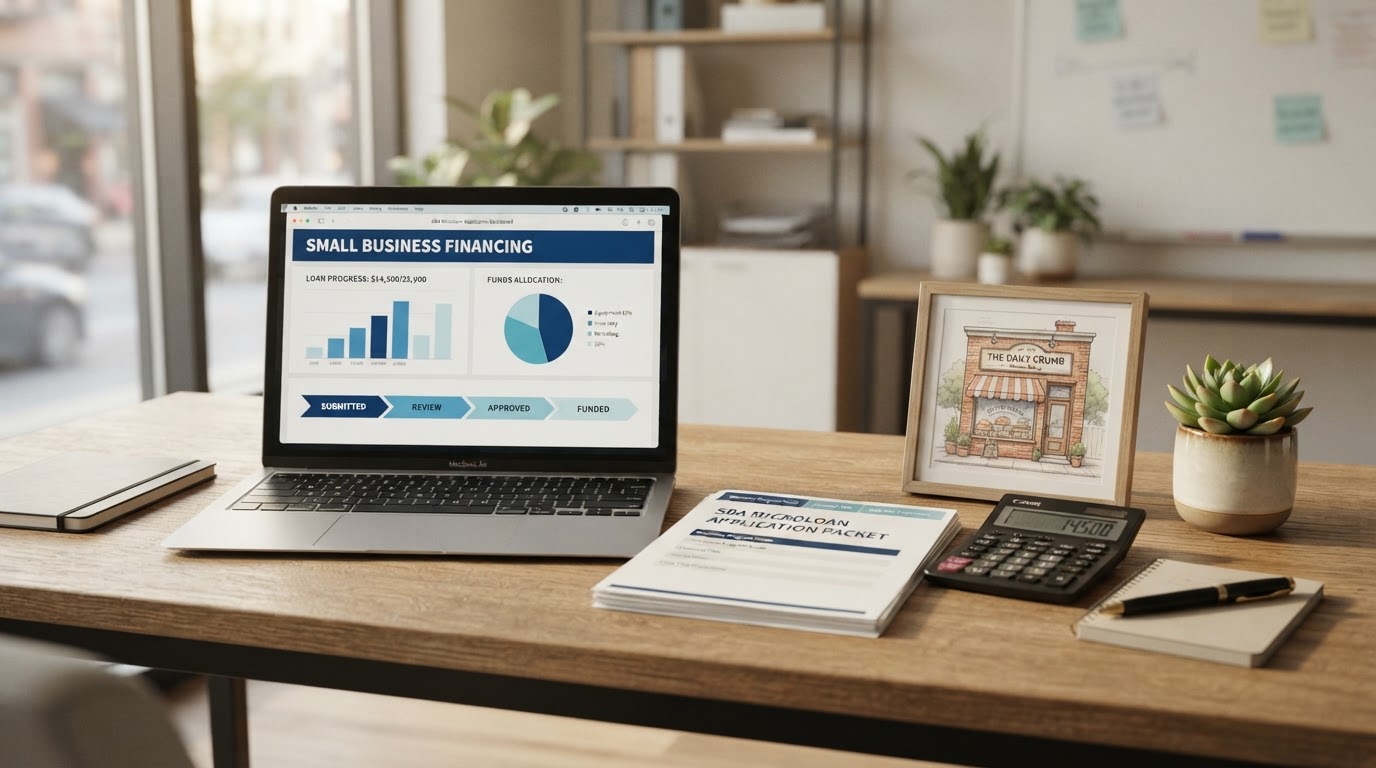
There is a particular frustration that Damon and Ashley Boswell hear from small business owners constantly: a business needs $15,000 or $25,000 — not a fortune, but enough to buy a second oven, stock inventory, hire a part-time employee, or bridge a gap — and the conventional bank treats the request as if it were a waste of paperwork. The bank is not wrong to hesitate. As Lendio explains, most banks are not set up to underwrite a $10,000 or $15,000 loan to a brand new business with limited credit history, because the paperwork and underwriting take just as long as they would for a much larger loan and the return is smaller, so a lot of banks simply pass. The result is a gap: the businesses that need the smallest amounts are often the ones conventional lending serves worst.
This is precisely the gap the SBA Microloan program was built to fill, and it is one of the funding paths Damon and Ashley Boswell recommend most often to early-stage and underserved businesses. In this guide, they break down exactly how SBA microloans work in 2026, what they cost, who qualifies, what the funds can cover, and when a microloan is the smartest path for a business that a conventional bank will not serve.
What an SBA Microloan Actually Is
An SBA microloan is a small-dollar, government-backed term loan provided not by the SBA directly but through a network of approved nonprofit intermediary lenders. As the SBA explains, the microloan program provides loans up to $50,000 to help small businesses and certain nonprofit childcare centers start up and expand, with the average microloan about $13,000. The SBA's 2026 update reinforces that the program provides loans from a few hundred dollars up to $50,000 — averaging around $13,000 — designed to help startups and small enterprises cover early costs, with lower loan sizes and flexible repayment terms designed for small business cash flow.
Ashley Boswell describes the structure plainly to every owner she speaks with: the SBA does not lend to you directly. It funds nonprofit, community-based intermediary lenders — often Community Development Financial Institutions — and those intermediaries lend to your business, setting their own credit, collateral, and documentation requirements within SBA guidelines. That structure is the entire point. Damon Boswell adds that because the intermediaries are community-based and mission-driven, they are built to serve the borrowers conventional banks pass over — startups, underserved entrepreneurs, and businesses with thin credit files but realistic cash flow projections. The microloan program is one of the few funding paths designed from the ground up for exactly the businesses that most need it.
Amounts, Rates, and Terms
The numbers are some of the most borrower-friendly in small business lending. Lendio summarizes the key terms: loan amounts up to $50,000 with an average of about $13,000, a loan structure that is a term loan rather than a line of credit, repayment terms up to seven years, interest rates typically between 8% and 13%, and packaging fees up to 3% of the loan amount plus closing costs set by the intermediary. The SBA's own lender resources confirm that each microloan must be repaid within six years, with maximum interest rates set as the rate charged to the intermediary plus 7.75% for loans over $10,000 and plus 8.5% for loans of $10,000 or less.
Damon Boswell puts those numbers in context: an 8% to 13% rate on a small-dollar term loan with up to seven years to repay and no balloon payment is an exceptionally clean structure, especially compared to the effective cost of a short-term cash advance or a high-rate online loan a small business might turn to when a bank says no. Ashley Boswell adds the SBA's note that microloans allow for tailored repayment schedules at set interest rates without balloon payments — meaning the monthly payment is predictable and the loan is fully amortizing, so there is no large lump-sum waiting at the end. For a business that needs $20,000 to grow, the microloan is one of the lowest-cost, most predictable forms of capital available.
Who Qualifies
Eligibility is more accessible than most owners expect, and Damon and Ashley Boswell walk every applicant through the standards. The SBA states that to be eligible a business must be an operating for-profit business that is small under SBA size requirements. Lendio adds the specifics: the business must be a for-profit small business or certain nonprofit childcare center, all direct and indirect owners must meet SBA citizenship rules, most intermediaries prefer a personal credit score of 620 or higher though many will accept lower scores, the business must demonstrate current cash flow or realistic cash flow projections showing it can repay, most intermediaries require collateral plus a personal guarantee, the business must operate within the intermediary's geographic service area, and while there is no SBA-wide minimum time in business, individual lenders may set their own thresholds.
Ashley Boswell emphasizes that last point for every founder she advises: the intermediary's own standards matter as much as the SBA's, which means finding the right intermediary is part of qualifying. A business declined by one intermediary may be approved by another in the same region with different credit or time-in-business thresholds. Damon Boswell adds that roughly a quarter of all SBA microloans go to startups — businesses operating for two years or less — which makes the microloan one of the few government-backed options built specifically for the earliest stage. And Lendio notes that some intermediaries require borrowers to complete a workshop or training program before or alongside the loan, which Damon and Ashley Boswell see not as a hurdle but as a strength: the training improves the business's odds of success, and the intermediary's mentorship is part of what makes the program effective.
What Microloan Funds Can and Cannot Cover
Understanding the eligible uses prevents wasted applications, and the SBA is specific. The SBA states that microloans can be used to purchase working capital, inventory, supplies, furniture, fixtures, machinery, and equipment, and Lendio adds that they can cover short-term expenses and be used to start or expand a business. The SBA's 2026 update lists the same eligible needs — working capital, inventory, equipment, supplies, and covering short-term expenses.
Damon Boswell is equally clear about what microloans cannot cover. The SBA prohibits using microloan funds to pay off existing debt, purchase real estate, or for personal expenses, and Lendio adds legal settlements to the restricted list. Ashley Boswell translates that into practical guidance: a microloan funds the things that let a business operate and grow — inventory to sell, equipment to produce, supplies to function, and working capital to bridge the gap to revenue. It does not fund a building purchase, and it cannot rescue a business from existing debt it cannot service. A founder who needs $40,000 for a second oven, an inventory order, and three months of operating runway is a textbook microloan fit. A founder hoping to use a microloan to pay off a defaulted loan is not, and an honest use-of-funds statement upfront saves everyone time.
How to Apply, Step by Step
The application process is more navigable than a conventional loan, and Damon and Ashley Boswell walk every owner through it. Lendio outlines the sequence: first, the SBA funds intermediary lenders — the nonprofit, often CDFI intermediaries — who then fund borrowers. Second, each intermediary sets its own credit, collateral, and documentation requirements within SBA guidelines and defines its geographic service area. Third, the borrower connects with an intermediary using the SBA's microlender directory or Lender Match tool to find one that serves their area. Fourth, the intermediary underwrites the loan, reviewing the application, business plan, financials, credit, and any required collateral, with some intermediaries requiring a workshop or training program first. Fifth, once approved, the intermediary issues the loan as a term loan with a fixed repayment schedule. Sixth, the borrower repays the intermediary — not the SBA — over a term of up to seven years.
Ashley Boswell stresses the documentation that makes the strongest application: a written business plan, current financial statements or realistic cash flow projections, proof of any collateral, and a clear, specific explanation of how the funds will be used. Damon Boswell adds that determining how much you actually need — and sizing the request to the microloan's $50,000 ceiling — is critical. A $15,000 need is a routine microloan request; a $200,000 need is not a microloan at all and should be routed to an SBA 7(a) loan or another product. Sizing the request correctly to the right program is what separates an approved application from a declined one.
When a Microloan Beats a Conventional Bank Loan
The microloan's clearest advantage is for the borrowers conventional banks underserve, and Damon and Ashley Boswell are specific about when it wins. Lendio identifies the fit: a startup without the time-in-business history conventional lenders usually require, a small business needing less than $50,000, a business unable to secure traditional financing, or a small business owner looking for both funding and mentorship. The SBA's 2026 update reinforces that a large traditional bank loan can be more cumbersome than it is worth when seeking a smaller-sized loan, which is exactly where the microloan program steps in.
Damon Boswell's favorite example is the bakery owner who needs a second oven and a part-time hire — roughly $18,000 with a 660 credit score is a clean fit for a microloan, as Lendio notes, and would struggle at a conventional bank. The detailing business owner asking for $10,000 in working capital with no time in business but solid cash flow projections and some personal collateral is, per Lendio, closer to realistic approval than they might expect from a conventional bank. Ashley Boswell adds the mentorship advantage: because many intermediaries require or offer training alongside the loan, a microloan comes with guidance that a conventional bank loan does not — and for a first-time entrepreneur, that combination of capital and counsel is often worth more than the money itself.
Microloans vs. Other Funding Paths
The microloan is powerful, but it is one tool among many, and Damon and Ashley Boswell help owners weigh it against alternatives. For a need above $50,000, an SBA 7(a) loan extends to $5 million with similar government backing. For a business that cannot wait for the microloan's underwriting timeline — which can take longer than a fast cash advance — a business cash advance delivers speed but at a higher effective cost. For a credit-strong owner, 0% credit card stacking offers interest-free capital for a set period. For a business with unpaid invoices, invoice financing unlocks trapped cash. And for an owner who only needs capital occasionally, a business line of credit provides reusable, on-demand funds.
Damon Boswell's guidance is to match the tool to the need. A microloan is the right choice when the need is under $50,000, the business is early-stage or underserved, the owner values low cost and mentorship over maximum speed, and the funds cover working capital, inventory, or equipment. When the need is larger, faster, or for a purpose the microloan excludes, a different tool will serve the business better. Ashley Boswell adds that applying for the wrong product first — a microloan for a $150,000 need, or a cash advance for a $15,000 planned purchase — wastes time and can leave an avoidable hard inquiry on the owner's credit.
Is an SBA Microloan Right for You?
Damon Boswell's readiness test is direct: Do you need $50,000 or less for working capital, inventory, supplies, furniture, fixtures, or equipment? Are you a for-profit small business or qualifying nonprofit childcare center, with owners meeting SBA citizenship rules? Is your personal credit score at or above 620, or can you find an intermediary that accepts a lower score? Can you demonstrate current cash flow or realistic projections that show you can repay, and can you offer collateral and a personal guarantee if required? And have you used the SBA's microlender directory or Lender Match to find an intermediary serving your area? If you can answer yes to these, an SBA microloan is a realistic, low-cost path to the capital your business needs.
If you are unsure where your business stands, that is exactly what our AI Funding Match Calculator is built to clarify. The calculator weighs your revenue, credit, timeline, and goals, and Damon and Ashley Boswell review every result personally. On a short phone call — no Zoom required — we will help you determine whether a microloan fits your need, which intermediary to approach, and what documents and plan will make your application strongest.
The Bottom Line
When a business needs less than $50,000, a conventional bank loan is often the wrong tool — not because the business is unqualified, but because the bank is not built for the request. The SBA Microloan program was designed for exactly that moment, delivering small-dollar, low-rate, fully amortizing capital through nonprofit intermediaries that serve the startups and underserved businesses conventional lenders pass over, often with mentorship that improves the odds of success. Damon and Ashley Boswell have helped small businesses across the United States, Puerto Rico, and Canada access microloans, and the businesses that succeed are the ones that size the request correctly, prepare the documents and business plan each intermediary expects, and match the program to the need rather than chasing a conventional loan that was never going to fit.
See whether a microloan fits your business. Complete the AI Funding Match Calculator in under 60 seconds, and Damon and Ashley Boswell will walk through your need, your options, and your next step on a quick phone call — so the small amount of capital your business needs arrives on terms that actually make sense.
Damon Boswell and Ashley Boswell
Funding specialists at ASAP Capital Solutions, helping business owners find the right capital across the United States, Puerto Rico, and Canada.
Find Your Funding Match in 60 Seconds
Complete the AI Funding Match Calculator and Damon and Ashley Boswell will review your matches on a quick phone call.
Get My Funding Match

