
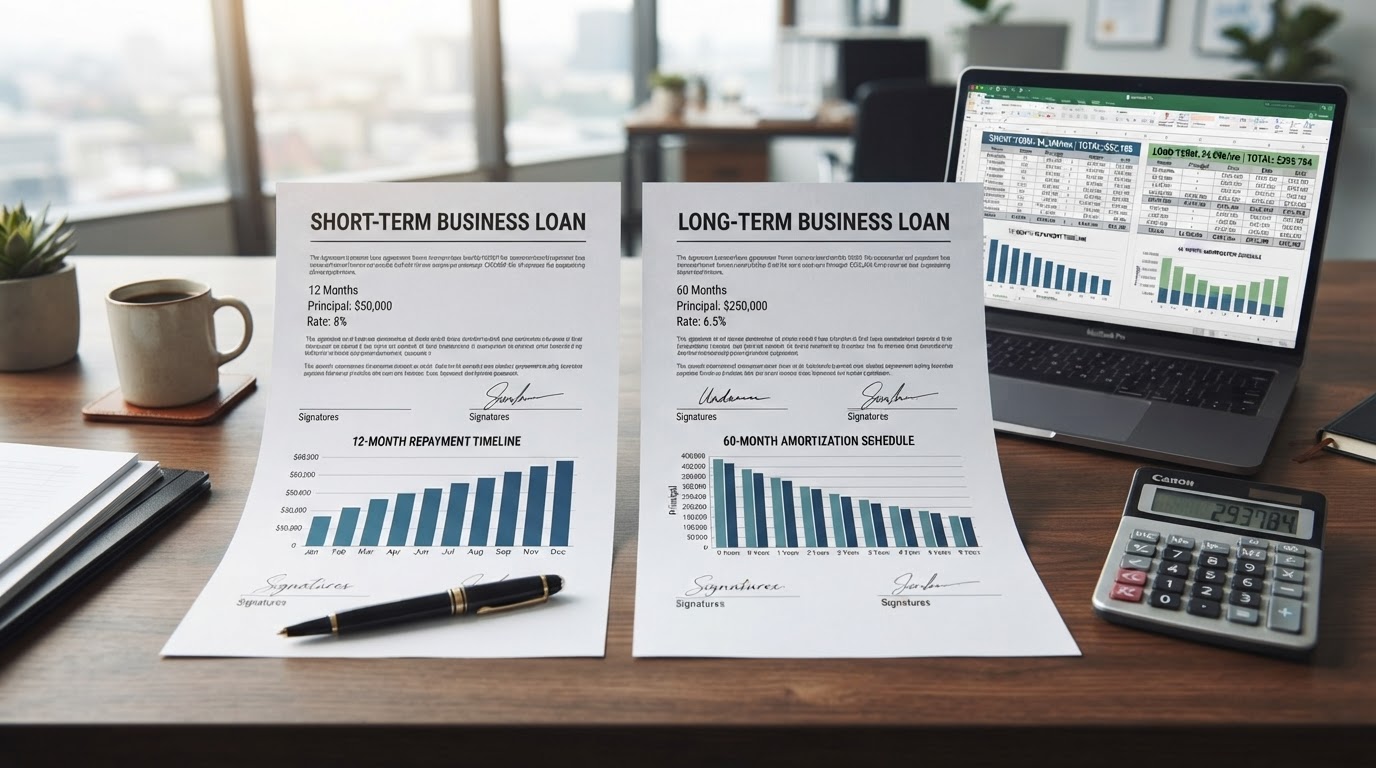
Most business owners choose a loan the way they choose a tool — by what it does, not by how long it lasts. But in business funding, the length of the loan is not a secondary detail. It is the decision. A short-term loan and a long-term loan are fundamentally different products, and matching the wrong term to the wrong purpose is one of the most expensive mistakes an owner can make. At ASAP Capital Solutions, Damon and Ashley Boswell see the consequences constantly: an owner takes a short-term loan for a long-term investment and drowns in payments the investment cannot yet support, or takes a long-term loan for a quick need and pays years of interest on capital that was used up in months.
In this guide, Damon and Ashley Boswell break down exactly how short-term and long-term business loans compare, what each one costs, how the payments differ, who qualifies, and how to match the term to the purpose so the funding serves the business rather than straining it.
What Defines a Short-Term vs. Long-Term Loan
The distinction is straightforward in structure but profound in impact. A short-term business loan typically carries a repayment term of 3 to 24 months, with payments often made daily, weekly, or monthly. A long-term business loan extends from 1 year up to 25 years, with monthly payments amortized over the full term. As Fora Financial notes, short-term loans run 3 to 24 months, while longer-term bank or SBA products extend far beyond, with real estate loans reaching 25-year terms.
Ashley Boswell translates the distinction into practical terms: the term length determines two things that matter enormously — the size of each payment and the total cost of the capital. A shorter term means larger payments but lower total interest. A longer term means smaller payments but higher total interest. Damon Boswell adds that the term also determines what the loan can responsibly fund. A short-term loan must be repaid from near-term revenue, so it must fund something that generates a return quickly. A long-term loan can be repaid over years, so it can fund investments that take time to pay off. Misaligning the term to the purpose is the core error.
Cost: Total Interest vs. Monthly Burden
The cost trade-off between the two is the heart of the decision. A short-term loan carries a higher effective cost per dollar per month but is outstanding for a shorter period, so the total interest paid can be lower. A long-term loan carries a lower rate but is outstanding for years, so the total interest paid over the life of the loan can be significantly higher. Damon Boswell walks owners through both calculations every time: the monthly payment is what affects cash flow today, and the total cost is what affects the business over the life of the loan.
Ashley Boswell's framework is to model both. A $100,000 short-term loan at a higher rate repaid in 12 months might cost $15,000 in total interest but demand $9,500 per month. A $100,000 long-term loan at a lower rate repaid over 7 years might cost $25,000 in total interest but demand only $1,500 per month. The short-term loan is cheaper overall but demands far more cash flow each month. The long-term loan is more expensive overall but protects monthly cash flow. Neither is universally better — the right choice depends on whether the business can absorb the monthly payment and whether the investment generates a return within the term.
Payment Frequency and Cash Flow Impact
Payment frequency is where short-term loans create the most strain. Many short-term loans and merchant cash advances require daily or weekly payments rather than monthly ones. As Upwise Capital warns, some products require daily or weekly payments rather than one monthly payment, and that frequency can strain cash flow during slow periods even when the total cost seems manageable on paper. A daily remittance that feels light on a busy day can become suffocating on a quiet one.
Damon Boswell's guidance is to model the payment against the business's slowest revenue period, not its average. If the business can absorb the daily or weekly payment during its worst weeks, the short-term loan is viable. If not, the structure will strain operations regardless of the total cost. Long-term loans, by contrast, almost always use monthly payments, which are easier to budget and align with most businesses' revenue cycles. Ashley Boswell adds that the predictability of a monthly payment is a genuine advantage for long-term planning — the business knows exactly what it owes each month for years, which simplifies cash flow forecasting and budgeting.
Qualification: What Lenders Require
Qualification differs significantly between the two. Short-term loans from alternative lenders typically require less documentation and weaker credit — often three to six months of bank statements and a modest credit threshold — because the lender is underwriting on recent revenue performance and a short repayment window. Long-term loans, particularly from banks and SBA lenders, demand stronger credit, more time in business, fuller financial documentation, and often collateral. The SBA notes that 7(a) loan eligibility requires the business to be creditworthy, demonstrate a reasonable ability to repay, and be unable to obtain credit on reasonable terms from non-government sources.
Damon Boswell frames the trade-off: the short-term loan is more accessible but more demanding on cash flow. The long-term loan is harder to qualify for but gentler on monthly cash flow. Ashley Boswell adds that newer businesses or those with challenged credit often start with short-term products and graduate to long-term loans as their credit, revenue, and time in business strengthen. The two products serve businesses at different stages of maturity, and the right term often shifts as the business grows.
Matching the Term to the Purpose
This is the section Damon and Ashley Boswell spend the most time on, because it is where most owners go wrong. The term must match the life of the asset or the return window of the investment. A short-term loan is appropriate for needs that generate a return quickly — inventory for a confirmed order, bridging a gap before a known payment, emergency equipment repair, seasonal stock-up. The capital is used up or converted to revenue within months, and the loan is repaid from that revenue.
A long-term loan is appropriate for investments that take years to pay off — real estate, major equipment, business acquisition, large-scale expansion, refinancing higher-cost debt. As the SBA outlines, 7(a) loans can run 10 years for most purposes and up to 25 years for real estate, because the assets they fund have useful lives that extend over those periods. Damon Boswell's rule is simple: never finance a long-term asset with a short-term loan, because the payments will come due before the asset generates enough return to cover them. Never finance a short-term need with a long-term loan, because you will pay interest for years on capital that was consumed in months. Ashley Boswell adds that the strongest businesses match each loan to a specific, forecasted return and a specific repayment source tied to that return.
The Refinancing Bridge: Short-Term to Long-Term
One strategy Damon and Ashley Boswell recommend frequently is using a short-term loan as a bridge to long-term financing. A business that needs capital immediately but cannot yet qualify for a long-term loan may take a short-term product to address the need, then refinance into a longer-term loan once the business's credit, revenue, or time in business improves. This approach trades a higher short-term cost for access, then captures the lower long-term cost when qualification becomes possible.
Damon Boswell cautions that this strategy requires discipline. The short-term loan must be repaid or refinanced before it strains cash flow, and the business must actively work toward the credit and financial profile that long-term financing requires. Ashley Boswell adds that refinancing short-term debt into a long-term loan can dramatically reduce monthly payments and free cash flow — but only if the business qualifies for the long-term product before the short-term one becomes unmanageable. Timing matters, and the bridge only works if the business crosses it before the short-term payments overwhelm the cash flow.
Collateral and Security
Collateral requirements differ between the two. Short-term loans from alternative lenders are often unsecured, underwritten on revenue alone, which is part of their accessibility. Long-term loans, particularly larger ones, frequently require collateral — real estate, equipment, inventory, or a blanket lien on business assets. The SBA notes that for 7(a) loans over $50,000, lenders follow their collateral policies, and loans are not declined solely for inadequate collateral, but collateral is often part of the structure.
Ashley Boswell explains the trade-off: an unsecured short-term loan is faster and simpler but carries a higher rate and more aggressive repayment. A secured long-term loan offers a lower rate and longer term but puts the pledged asset at risk. Damon Boswell adds that for owners with valuable collateral and a long-term need, a secured long-term loan is almost always the more cost-effective path. For owners without collateral or with a short-term need, an unsecured short-term loan is the realistic option, provided the revenue can support the payments.
The Risks of Each
The risks of each product mirror their structures. The short-term loan's primary risk is cash flow strain — the higher payments and frequent remittance schedule can overwhelm a business during slow periods, and as NerdWallet warns, the high cost coupled with frequent payments can trap a business in a cycle of debt. The long-term loan's primary risk is total cost — the extended term means the business pays significantly more interest over the life of the loan, and if the business sells or closes before the loan is repaid, the remaining balance may come due.
Damon Boswell's cautions are specific. For short-term loans, never take one without modeling the slowest revenue weeks against the payment. For long-term loans, never take one without calculating the total interest over the full term and confirming the investment generates a return that justifies that total cost. Ashley Boswell adds a common pitfall for both: prepayment penalties. Some long-term loans charge fees for early repayment, which can erase the savings of paying off the loan early. The owner must understand the prepayment terms before signing, because they affect the flexibility to refinance or exit the loan early.
Is a Short-Term or Long-Term Loan Right for You?
Damon Boswell's readiness test is direct: Does the need generate a return within the loan term? Can your slowest revenue periods absorb the payment frequency? Is your credit and time in business sufficient for the product you are pursuing? Does the total cost of the loan justify the return the capital will generate? And does the term match the life of the asset or the return window of the investment? If you can answer yes to these, the term you have chosen is the right one. If the term and the purpose are misaligned, no rate or approval makes the loan a good fit.
If you are unsure where your business stands, that is exactly what our AI Funding Match Calculator is built to clarify. The calculator weighs your revenue, credit, timeline, and goals, and Damon and Ashley Boswell review every result personally. On a short phone call — no Zoom required — we will help you determine whether a short-term or long-term loan fits your need, your cash flow, and your timeline.
The Bottom Line
The term of a business loan is not a footnote — it is the decision that determines the monthly payment, the total cost, and whether the funding fits the purpose it serves. A short-term loan delivers capital fast and cheaply in total but demands heavy monthly cash flow. A long-term loan delivers capital at a lower monthly cost but over a longer, more expensive life. Damon and Ashley Boswell have helped owners across the United States, Puerto Rico, and Canada match the term to the purpose, and the businesses that succeed are the ones that align the loan's life with the investment's return rather than choosing a term based on whatever is easiest to approve.
See which term fits your business. Complete the AI Funding Match Calculator in under 60 seconds, and Damon and Ashley Boswell will walk through your need, your cash flow, and your next step on a quick phone call — so your loan term serves your purpose instead of working against it.
Damon Boswell and Ashley Boswell
Funding specialists at ASAP Capital Solutions, helping business owners find the right capital across the United States, Puerto Rico, and Canada.
Find Your Funding Match in 60 Seconds
Complete the AI Funding Match Calculator and Damon and Ashley Boswell will review your matches on a quick phone call.
Get My Funding Match

