
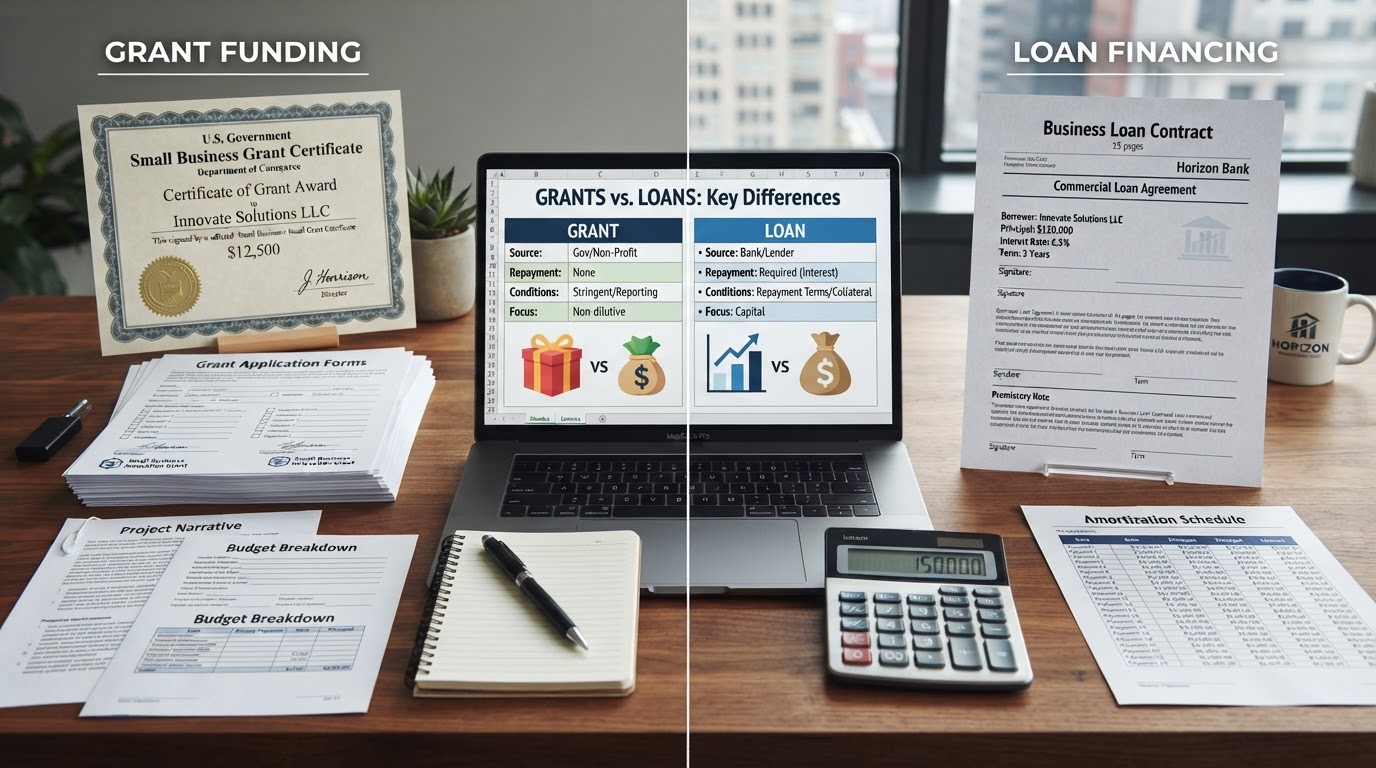
Whenever Damon and Ashley Boswell sit down with a business owner who needs capital, one question comes up almost every time: why not just get a grant? The appeal is obvious. A grant is money you do not have to pay back. A loan is money you do. On paper, there is no contest. In practice, the two are not even in the same conversation, because grants and loans solve fundamentally different problems on fundamentally different timelines. Understanding the difference is the first step toward funding that actually arrives when your business needs it.
At ASAP Capital Solutions, Damon and Ashley Boswell have walked hundreds of owners through this comparison, and the takeaway is always the same. Grants are real, and when they align with your business they are genuinely free money. But they are competitive, slow, restricted, and never guaranteed. Loans are not free, but they are predictable, fast, flexible, and available to businesses that no grant program would ever fund. In this guide, Damon and Ashley Boswell break down exactly how grants and loans compare, what each one requires, and how to decide which to pursue without wasting months chasing the wrong one.
What a Small Business Grant Actually Is
A small business grant is an award of capital — typically from a government agency, a corporation, a foundation, or a nonprofit organization — that does not have to be repaid, provided the recipient meets the conditions attached to the award. As the SBA is careful to state on its own grants page, the agency does not provide grants for starting and expanding a business. Instead, SBA grants go to nonprofits, resource partners, and educational organizations that support entrepreneurship through counseling and training programs. That distinction matters enormously, because many owners assume the SBA hands out grants directly to for-profit businesses, and it does not.
Damon Boswell is direct about what this means: the federal grant programs most owners imagine when they hear the word grant are, with very few exceptions, not available to a typical for-profit small business. The grants that do exist — corporate-sponsored competitions, state and local economic development programs, industry-specific awards, and targeted programs for specific demographics or regions — are real, but they are narrow. Ashley Boswell adds that the SBA itself warns owners to be suspicious of anyone claiming to offer an SBA grant, because the agency only communicates from official email addresses and does not solicit grant applications from individual businesses. If someone is pitching you an SBA grant for your restaurant or your plumbing company, that is not how the program works.
The Qualifications for a Grant
When a grant is available to for-profit businesses, the qualification bar is specific. As Sesloc Federal Credit Union outlines, to qualify for small business grants a company must typically be a for-profit business of any structure, independently owned and operated, physically operated in the United States or its territories, not nationally dominant in its field, and within SBA size standards. Beyond those basics, individual grants add their own criteria — a specific industry, a specific demographic, a specific geography, or a specific use of funds.
Ashley Boswell translates this into practical guidance: a grant does not evaluate whether your business can repay capital. It evaluates whether your business fits the purpose the grantor wants to fund. A grant for women-owned manufacturers in rural counties is not available to a male-owned restaurant in a city, no matter how strong the business is. The qualification is about fit, not about financial strength. Damon Boswell adds that grant applications also require a compelling case — a detailed proposal, a clear use of funds, a documented community or economic impact, and often matching contributions or in-kind support. A grant application is closer to writing a business plan and a funding proposal than to filling out a loan application, and the effort is significant.
What a Business Loan Actually Is
A small business loan is capital you borrow and repay with interest over a fixed period. Unlike a grant, a loan is available year-round, from a wide range of lenders, to businesses across virtually every industry. As Sesloc explains, a small business loan is designed to help companies get financing for their operations, and because these loans are offered directly through financial institutions they may have different lending requirements such as business size, cash flow projections, and credit history.
Damon Boswell frames the core distinction: a loan is a commercial transaction. The lender evaluates whether your business can repay the capital, and in return for taking on that risk, the lender charges interest. The relationship is predictable — you know the amount, the rate, the term, and the payment before you sign. Ashley Boswell adds that loans come in many forms — term loans, lines of credit, equipment financing, merchant cash advances, invoice financing, SBA-backed loans — each designed for a different need, but all sharing the same fundamental structure of borrow and repay. The breadth of loan products is what makes them available to businesses at every stage, in every industry, with every type of revenue pattern.
Speed: The Decisive Difference
If there is one difference that Damon and Ashley Boswell stress more than any other, it is speed. A grant cycle typically runs on a timeline of months to more than a year. There is an application window, a review period, a scoring or selection process, an announcement, and a disbursement schedule — and at every stage, the business is competing against other applicants for a limited pool of funds. As Sesloc notes, businesses must apply before the deadline with an outline of how they plan to satisfy the grant requirements, and the outcome is never guaranteed regardless of how strong the application is.
Damon Boswell is blunt: a business with a payroll gap, a broken piece of equipment, an expiring inventory discount, or a time-sensitive growth opportunity cannot wait for a grant. The timeline of a grant and the timeline of a business need almost never align. A merchant cash advance or a short-term loan can fund in a matter of days. A line of credit can be drawn the moment a gap appears. An SBA loan, the slowest of the loan products, still typically closes in weeks to a few months — far faster than the typical grant cycle. Ashley Boswell adds that the speed difference is not a minor advantage. It is the difference between funding that solves a problem and funding that arrives after the problem has already cost the business money.
Availability and Competition
Availability is the second decisive difference. Grants are limited in number, limited in total funding, and limited in who they serve. A grant program might award ten businesses out of five hundred applicants, or it might fund a single industry in a single region for a single year. The competition is real, and even a strong application can lose to a stronger one. Loans, by contrast, are available continuously from dozens of lenders serving virtually every industry and business stage. A business that qualifies for a loan can access one today; a business that qualifies for a grant can only access one if a program happens to be open, the business happens to fit, and the application happens to win.
Damon Boswell frames the practical reality: grants are a maybe, and loans are a yes-or-no. A maybe is not a funding strategy. A business that depends on winning a grant to solve a current cash need is betting on an outcome it cannot control. Ashley Boswell adds that this does not mean grants are worthless — when a grant aligns with your business and your timeline, it is genuinely free capital and worth pursuing. But it means grants should supplement a funding strategy, not be the foundation of one. The foundation is the capital you can access reliably, and that is what loans provide.
Cost: Free Money vs. Borrowed Money
The cost comparison is where the grant's appeal is strongest and where the loan's trade-off is clearest. A grant, if awarded, is free — the capital does not have to be repaid, provided the conditions are met. A loan costs money in the form of interest or a factor rate, and as NerdWallet's September 2026 rate data shows, that cost varies widely by product: bank small-business loans run roughly 6.37% to 10.98%, online term loans range from 14% to 99% APR, SBA loans run about 10% to 15%, equipment financing 4% to 45%, and merchant cash advances 40% to 350% APR when annualized.
Damon Boswell is honest about the math: if you can get a grant, a grant is cheaper than any loan, because free is cheaper than any interest rate. The question is whether you can get a grant, when you can get it, and whether the amount and the use align with your need. Ashley Boswell adds the nuance that owners often miss: the cost of a loan must be weighed against the return the capital generates. A loan that funds inventory for a confirmed holiday order at a 15% APR, when that order triples monthly revenue, is not expensive — it is profitable. A grant that arrives nine months after the holiday season is irrelevant to that opportunity. Cost is only meaningful in the context of timing and return, and that is where loans consistently outperform grants for active business needs.
Use of Funds: Restricted vs. Flexible
Grants almost always come with restrictions on how the money can be spent. A grant for equipment requires the funds to purchase equipment. A grant for hiring requires the funds to pay new employees. A grant for research requires the funds to support that specific research. The grantor wants the capital used for the purpose it was awarded, and it will require documentation proving that it was. Loans, by contrast, are typically far more flexible. A working capital loan can fund payroll, inventory, marketing, repairs, or any combination of operating expenses the business faces.
Ashley Boswell notes that the flexibility of a loan is part of what makes it a better fit for the unpredictable reality of running a business. A gap rarely arrives in the exact form an owner expects — the need shifts, the timing shifts, the amount shifts. A loan adapts to the need because the business controls how the capital is deployed. A grant is purpose-built for the specific use the grantor defined, and using it for anything else violates the terms of the award. Damon Boswell adds that for businesses with clear, specific, grant-eligible needs and the timeline to wait, a restricted grant can be the right tool. For businesses facing real, immediate, and evolving needs, the flexibility of a loan is not just convenient — it is essential.
Eligibility: Fit vs. Repayment Ability
The eligibility frameworks are fundamentally different. A grant evaluates fit — does your business match the population the grantor wants to serve? A loan evaluates repayment ability — can your business generate the cash flow to repay the capital? As the SBA outlines, grant recipients must meet specific requirements tied to the program, while loan borrowers must meet lending requirements tied to credit, revenue, time in business, and debt capacity. The two systems are evaluating different things, which is why a business can be a perfect grant fit and a weak loan candidate, or a strong loan candidate and an ineligible grant applicant.
Damon Boswell's guidance is to understand which evaluation your business will pass before investing time in an application. If your credit is strong, your revenue is consistent, and your need is time-bound, a loan is almost always the faster, more reliable path. If your business fits a specific grant program, your timeline is flexible, and the use of funds matches the grant's purpose, a grant is worth pursuing alongside the loan rather than instead of it. Ashley Boswell adds that the strongest funding strategy often combines both — a loan to address the immediate need, and a grant application running in the background for a future, aligned opportunity.
The Realistic Outcome: What to Pursue
Damon and Ashley Boswell are candid about the realistic outcome for most business owners. Grants are worth pursuing when one is available, when the business qualifies, and when the timeline aligns. They are not worth betting a business need on. Loans are worth pursuing whenever the business can support repayment, because they are available, predictable, and fast. The businesses that succeed are the ones that treat grants as a bonus — free capital when the stars align — and treat loans as the reliable engine of their funding strategy.
Damon Boswell's framework is direct. If your need is urgent, pursue a loan. If your need is specific and a grant is open, apply for the grant in parallel. If your need is long-term and your credit and revenue are strong, a low-cost loan like an SBA product will almost always serve you better than waiting for a grant that may never come. Ashley Boswell adds that the most expensive funding decision is not the one with the highest interest rate — it is the one that arrives too late. A loan that funds a need on time, even at a cost, is cheaper than a grant that arrives after the need has already cost the business its customers, its reputation, or its momentum.
Is a Grant or a Loan Right for Your Business?
Damon Boswell's readiness test is practical. Is there an active grant program that fits your business, your industry, your location, and your use of funds? Is your timeline flexible enough to wait through the application and review cycle, which can run months or longer? Can you absorb the cost of the loan you would otherwise take, or is the need urgent enough that waiting is not an option? If a grant fits and your timeline is flexible, apply — but do not let the application delay the funding your business actually needs. If your need is real and time-bound, a loan is the reliable path, and Damon and Ashley Boswell can help you match the right product to your revenue, credit, and goals.
If you are unsure where your business stands, that is exactly what our AI Funding Match Calculator is built to clarify. The calculator weighs your revenue, credit, timeline, and goals, and Damon and Ashley Boswell review every result personally. On a short phone call — no Zoom required — we will help you determine whether a loan, an SBA product, or a combination of funding tools is the right fit for your need, your cash flow, and your timeline.
The Bottom Line
Grants and loans are not competitors — they are tools for different situations. A grant is free money that is competitive, slow, restricted, and never guaranteed, and it is worth pursuing when the timing and the fit align. A loan is borrowed money that is available, predictable, flexible, and fast, and it is the foundation of a funding strategy for any business with real, time-bound needs. Damon and Ashley Boswell have helped owners across the United States, Puerto Rico, and Canada navigate both paths, and the businesses that succeed are the ones that treat grants as a bonus and loans as the engine — never the other way around.
See which funding path fits your business. Complete the AI Funding Match Calculator in under 60 seconds, and Damon and Ashley Boswell will walk through your matches, your timeline, and your next step on a quick phone call — so your business gets the capital it needs, when it needs it, from the source that actually delivers.
Damon Boswell and Ashley Boswell
Funding specialists at ASAP Capital Solutions, helping business owners find the right capital across the United States, Puerto Rico, and Canada.
Find Your Funding Match in 60 Seconds
Complete the AI Funding Match Calculator and Damon and Ashley Boswell will review your matches on a quick phone call.
Get My Funding Match

