
When a business needs short-term financing, two products come up more than any others: a working capital loan and a business line of credit. Both exist to keep operations running when cash flow gaps appear. Both can cover payroll, inventory, rent, and the day-to-day costs of staying in business. But as Damon and Ashley Boswell tell every owner they speak with, the two products are not interchangeable. They share a purpose, but their structures lead to very different outcomes depending on how and when the business needs the money. Choosing the wrong one for your situation can cost you far more than you expect.
In this guide, Damon and Ashley Boswell break down exactly how a working capital loan and a line of credit compare, what each one costs, how the repayment differs, who qualifies, and how to choose the structure that fits your cash flow rather than the one a lender happens to lead with.
The Core Difference: Lump Sum vs. Revolving
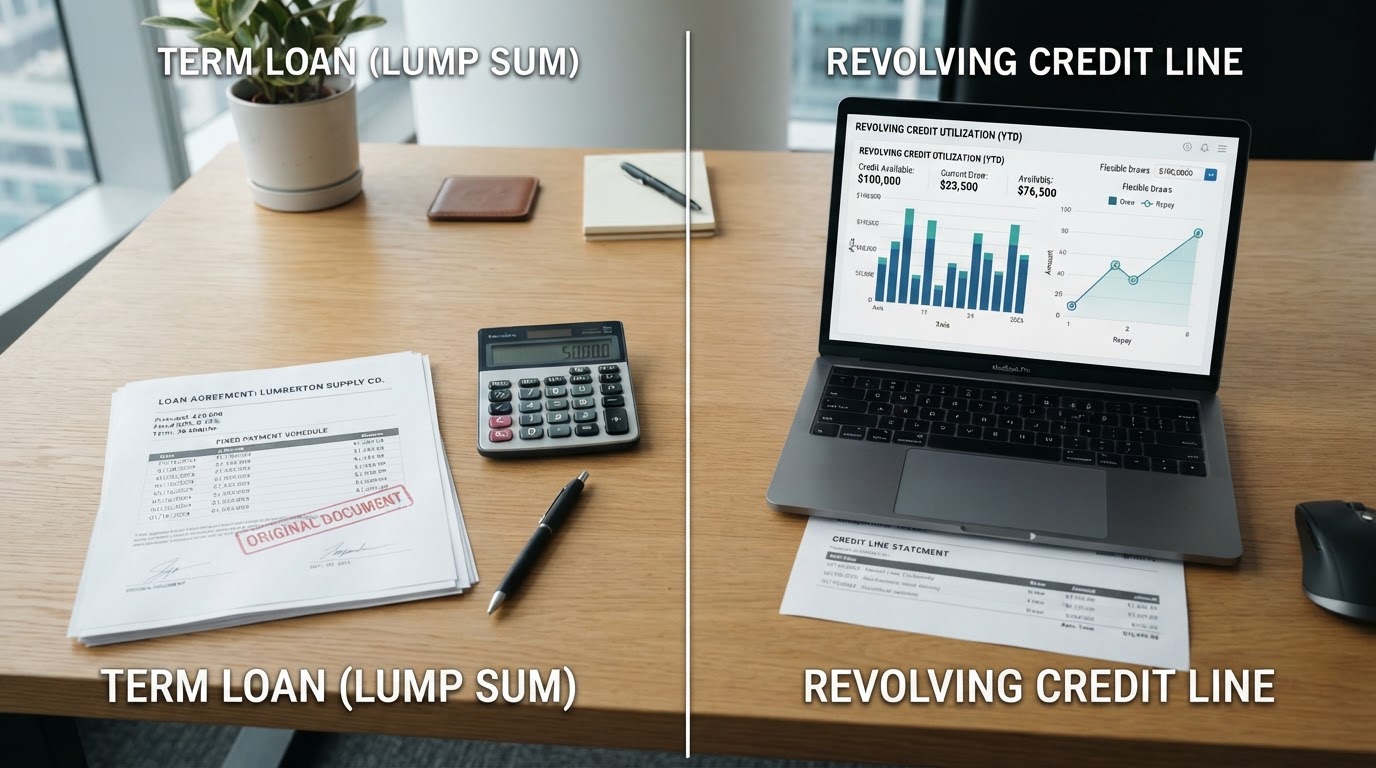
The distinction comes down to one word: structure. As Fora Financial explains, a working capital loan is a fixed borrowing — you receive the full approved amount at once, repay it over a defined term in scheduled installments, and the loan closes when it is paid off. A line of credit is revolving credit — you are approved for a maximum credit limit, draw what you need when you need it, repay what you have drawn, and the credit restores so you can draw again. That single structural difference cascades into everything else: how interest accrues, how repayment behaves, how reusable the capital is, and which cash flow pattern each product serves.
Ashley Boswell translates it plainly: a working capital loan is a one-time event. You get the money, you pay it back on a schedule, and when it is done, it is done — if you need more, you apply again. A line of credit is an ongoing relationship. The capital is there when you need it, gone from your cost when you do not, and available again the moment you repay it. Damon Boswell adds that this difference is not academic — it determines whether the product flexes with your revenue or demands a fixed outflow regardless of how the business performs.
How Interest Accrues: The Cost Difference
The way interest accrues is where the two products diverge most meaningfully for the business's bottom line. As Fora Financial notes, interest on a working capital loan is applied to the full loan amount from disbursement, while interest on a line of credit is applied only to the drawn balance, not the full credit limit. That means a business with a $100,000 line of credit that draws only $30,000 pays interest on $30,000 — not on the $100,000 it could have drawn. A working capital loan for $100,000 charges interest on the full $100,000 from day one, regardless of how quickly the business deploys it.
Damon Boswell walks owners through the implication: for a business that does not need the full amount all at once, a line of credit is almost always cheaper, because it only charges for what is actually used. For a business that needs a specific, known amount for a defined purpose, a working capital loan's full-amount interest is acceptable because the capital is being fully deployed. Ashley Boswell adds that the cost difference compounds over time. A business that draws $20,000 from a line of credit, repays it in two months, then draws $15,000 a month later pays interest only on those specific balances for those specific periods. A working capital loan taken for the same total need charges interest on the full amount for the entire term, even during months when the capital is sitting idle.
Repayment: Fixed Schedule vs. Flexible Restoration
Repayment behavior is the second major difference, and it shapes how each product affects monthly cash flow. A working capital loan has a fixed repayment schedule — daily, weekly, or monthly payments set at origination that do not adjust based on revenue performance. As Fora Financial warns, the payment comes out on the defined schedule regardless of what the business earned that period. That predictability is an advantage for budgeting but a risk for businesses with variable revenue, because the payment hits even in a slow month.
A line of credit offers flexible repayment — you repay what you have drawn, and the credit restores as you pay it down. As First Capital Federal Credit Union notes, the line of credit's repayment is variable and depends on usage, and the principal is flexible rather than fixed. Damon Boswell frames the trade-off: the working capital loan's fixed payment is predictable but rigid. The line of credit's flexible repayment is adaptable but requires discipline, because the minimum payment may only cover interest, allowing a balance to persist if the business does not actively pay down principal. Ashley Boswell adds that for businesses with consistent, predictable revenue, the fixed payment is manageable. For businesses with seasonal swings, project-based revenue, or uneven billing cycles, the revolving structure is almost always the better fit for the actual cash flow pattern.
Reusability: One-Time vs. Ongoing Access
Reusability is where the line of credit pulls decisively ahead for recurring needs. A working capital loan is a single-use facility — once it is repaid, it is closed, and the business must apply again to access more capital. A line of credit is reusable — as the business repays, the available credit restores, and the business can draw again without a new application. As First Capital Federal Credit Union outlines, the line of credit is revolving, meaning the business can reuse it as it repays, while the working capital loan is single-use and requires reapplication for more funds.
Damon Boswell explains why this matters: for a business with recurring cash flow gaps — seasonal inventory needs, monthly payroll cycles, periodic equipment repairs — the line of credit eliminates the friction of reapplying every time a gap appears. The capital is simply there. For a business with a one-time, defined need — a specific equipment purchase, a single expansion project, a defined refinancing — the working capital loan's lump sum is the more natural fit, because the business does not need ongoing access. Ashley Boswell adds that many established businesses use both: a working capital loan for a specific capital project and a line of credit running in the background for day-to-day cash flow management. The two complement each other when each is matched to its purpose.
Qualification: What Lenders Review
Qualification differs between the two in ways that matter for newer or growing businesses. As First Capital Federal Credit Union notes, lines of credit sometimes have slightly more flexible qualification requirements than term loans because the lender controls the credit limit and can manage risk incrementally. A working capital loan, particularly a short-term one from an alternative lender, may be more accessible on credit but demands stronger evidence that the business's revenue can support the fixed payments. A line of credit from a bank typically requires stronger business financials, more time in business, and a healthier credit profile, because the lender is committing to an ongoing facility rather than a one-time loan.
Damon Boswell's guidance is to match the product to the business's maturity. Newer businesses or those with challenged credit may find a working capital loan from an alternative lender more accessible, because the lump sum and fixed term give the lender a clearer repayment path. More established businesses with consistent revenue and stronger credit are better positioned for a line of credit, which rewards stability with lower cost and ongoing flexibility. Ashley Boswell adds that the qualification bar is not just about approval — it affects the rate. A business that qualifies for a line of credit at a bank will typically pay a lower rate than the same business would on a working capital loan from an alternative lender, because the bank's lower risk is reflected in the pricing.
When a Working Capital Loan Makes More Sense
Damon and Ashley Boswell recommend a working capital loan when the funding need is specific, the amount is known in advance, and the business does not expect to need repeated draws from the same facility. As Fora Financial notes, 45% of business owners borrow for expansion, 42% for refinancing existing debt, 28% for unexpected expenses, and 24% for inventory purchase — and each of these is a defined, one-time need that a lump sum loan serves well. The fixed payment schedule provides predictability, and the loan closes when it is repaid, which suits a business that wants a clear beginning, middle, and end to the obligation.
Damon Boswell adds that a working capital loan also makes sense when the business wants the discipline of a fixed repayment schedule — the structure forces repayment on a timeline, which can prevent the balance from lingering the way a line of credit's minimum payments might. Ashley Boswell notes that for a business that knows exactly how much it needs and exactly when it can repay, the working capital loan's simplicity is an advantage. There is no temptation to overdraw, no revolving balance to manage, and a clear end date after which the obligation is gone.
When a Line of Credit Makes More Sense
A line of credit makes more sense when the cash needs are ongoing, variable, or cyclical, and the business wants the flexibility to borrow only what it needs and repay on a schedule that matches its revenue flow. As First Capital Federal Credit Union advises, choose a business line of credit if your cash needs are recurring, variable, or unpredictable, and you want revolving access to capital without reapplying each time a gap arises. The interest-only-on-drawn-balance structure means the business pays only for the capital it actually uses, which is a meaningful cost saving for businesses that do not need the full amount all at once.
Damon Boswell frames the line of credit as a financial safety net the business controls — it sits unused and cost-free until the moment a gap appears, then deploys exactly the amount needed. Ashley Boswell adds that the line of credit is particularly powerful for seasonal businesses, which can draw ahead of peak season to stock up, repay from peak-season revenue, and then hold the line available for the off-season without paying for capital they are not using. The structure that flexes with revenue is the line of credit's defining advantage, and for businesses whose revenue does not move in a straight line, that flexibility is not a luxury — it is the difference between funding that supports the business and funding that strains it.
The Risks of Each Structure
Both structures carry risks, and Damon and Ashley Boswell are candid about each. The working capital loan's primary risk is the rigid payment — a fixed daily, weekly, or monthly outflow that hits regardless of revenue, which can strain a business during slow periods. As Upwise Capital warns, some products require daily or weekly payments that can strain cash flow even when the total cost seems manageable on paper. The line of credit's primary risk is the opposite — the flexibility can lead to overuse, with the business drawing repeatedly and carrying a persistent balance that, even at a lower rate, accumulates cost over time.
Damon Boswell's cautions are specific. For a working capital loan, model the slowest revenue period against the payment before signing. For a line of credit, establish discipline around when to draw and a plan to pay down balances rather than letting them revolve indefinitely. Ashley Boswell adds that both products require the same fundamental discipline: never borrow for expenses that produce no return, never miss a payment, and never stack multiple facilities of either type without a clear, forecasted repayment source for each.
Is a Working Capital Loan or Line of Credit Right for You?
Damon Boswell's readiness test is direct: Is your need a one-time, defined amount, or an ongoing, variable need? Do you want the predictability of a fixed payment, or the flexibility of revolving access? Does your revenue pattern support a fixed outflow, or does it fluctuate in a way that makes fixed payments stressful? And do you want the loan to close when repaid, or do you want ongoing access for future gaps? If your need is specific and one-time, a working capital loan is the natural fit. If your needs are recurring and variable, a line of credit gives you the flexibility and cost efficiency that a lump sum cannot.
If you are unsure where your business stands, that is exactly what our AI Funding Match Calculator is built to clarify. The calculator weighs your revenue, credit, timeline, and goals, and Damon and Ashley Boswell review every result personally. On a short phone call — no Zoom required — we will help you determine whether a working capital loan, a line of credit, or a combination of both is the right structure for your cash flow.
The Bottom Line
A working capital loan and a business line of credit both serve the same fundamental purpose — keeping a business running through cash flow gaps — but they do it in fundamentally different ways. The loan delivers a lump sum with a fixed repayment schedule, ideal for one-time, defined needs where predictability matters. The line of credit delivers revolving, flexible access, ideal for ongoing, variable needs where paying only for what you use saves real money. Damon and Ashley Boswell have helped owners across the United States, Puerto Rico, and Canada choose between them, and the businesses that succeed are the ones that match the structure to their cash flow pattern rather than defaulting to whichever product is pitched first.
See which structure fits your business. Complete the AI Funding Match Calculator in under 60 seconds, and Damon and Ashley Boswell will walk through your cash flow, your matches, and your next step on a quick phone call — so your working capital works the way your business actually runs.
Damon Boswell and Ashley Boswell
Funding specialists at ASAP Capital Solutions, helping business owners find the right capital across the United States, Puerto Rico, and Canada.
Find Your Funding Match in 60 Seconds
Complete the AI Funding Match Calculator and Damon and Ashley Boswell will review your matches on a quick phone call.
Get My Funding Match

