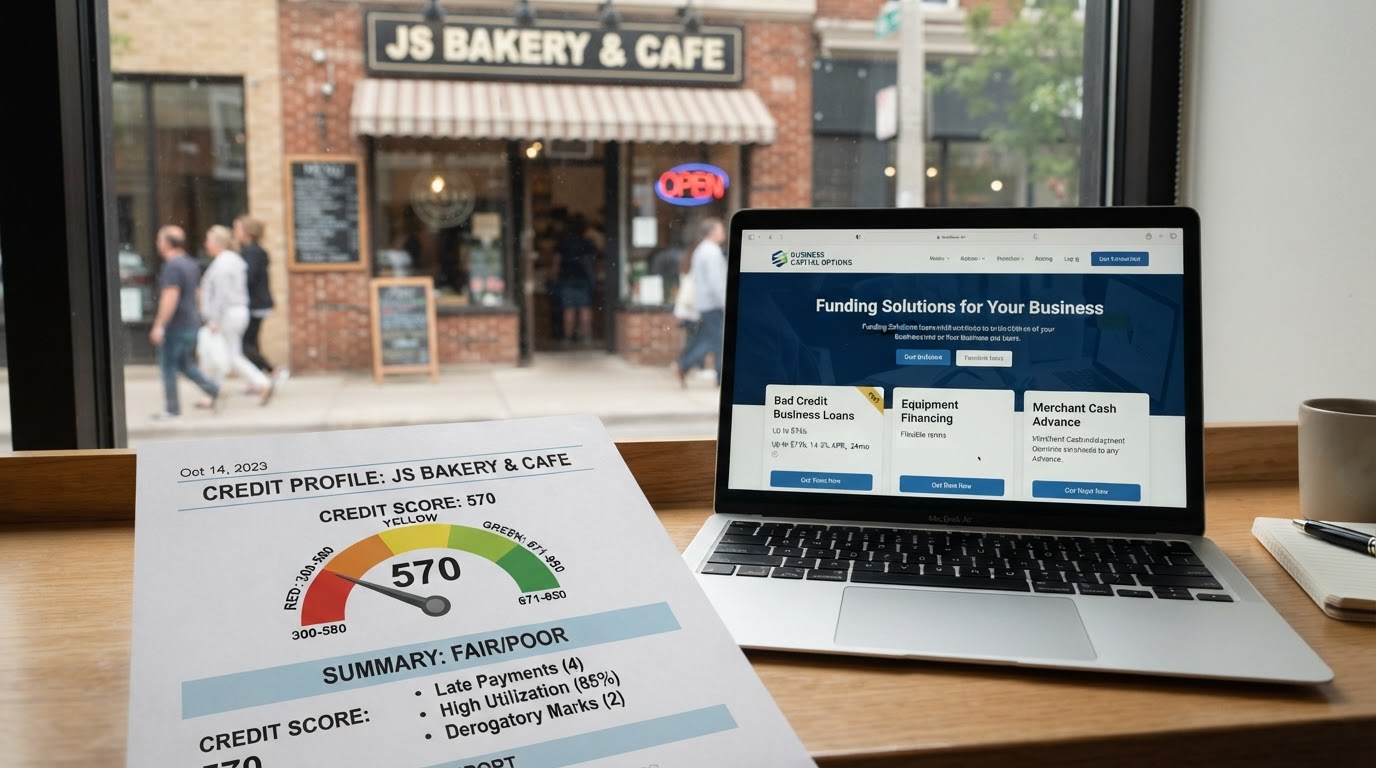
More business owners call ASAP Capital Solutions worried about one thing than almost any other: my credit is not great, so can I still get funding? Ashley and Damon Boswell give the same answer every time. Yes, you can. A low personal credit score narrows your options, but it does not eliminate them. The mistake most owners make is assuming a rejection from one traditional bank means funding is impossible, when the reality is that an entirely different category of financing is built specifically for businesses in their situation.
In this guide, Ashley and Damon Boswell walk through the real funding options available to credit-challenged business owners in 2026, what each one actually requires, and how to position your business to get approved even when your credit is not where you want it to be.
What 'Bad Credit' Actually Means to a Lender
First, it helps to understand what lenders are looking at. As Lendio explains in its 2026 guide to business loans for bad credit, several common funding types — including invoice factoring, equipment financing, revenue-based financing, and microloans — accept personal FICO scores as low as 500. That is a meaningful threshold, because it means a credit score that would be an automatic rejection at a traditional bank can still qualify for real, usable capital through alternative lenders.
Ashley Boswell is direct with every owner she speaks with: bad credit is not a moral judgment, it is a data point. Lenders use it to estimate risk, and different funding products weight it differently. A traditional bank loan weighs credit heavily. A revenue-based advance weighs your deposits and cash flow far more. An equipment loan weighs the value of the equipment itself. Damon Boswell adds that the key is matching your business to a product that underwrites on your strengths rather than one that punishes your weaknesses.
Revenue-Based Financing: When Your Deposits Matter More Than Your Score
Revenue-based financing — sometimes called a merchant cash advance — gives you a lump sum today in exchange for a fixed percentage of your future daily or weekly sales until the agreed amount is repaid. Lendio notes that if your business has steady revenue but uneven credit and you need cash within days rather than weeks, revenue-based financing is often considered. Loan amounts can range from $5,000 to $250,000 with funding as fast as the same day.
This is the path Ashley and Damon Boswell recommend most often for credit-challenged owners who have consistent deposits. The lender is not asking whether your credit is perfect; they are asking whether your business generates enough revenue to support repayment. Damon Boswell's caution is the same one he gives for any advance: understand the total dollar cost, not just the headline, and make sure your revenue can comfortably support the daily or weekly remittances.
Invoice Factoring: Turning Unpaid Invoices Into Cash
If your business sells to other businesses on net-30 or net-60 terms and your cash flow is bottlenecked by slow-paying customers, invoice factoring can convert those accounts receivable into immediate working capital. As Lendio explains, factoring sells your unpaid B2B or B2G invoices to a factoring company at a small discount — you receive the majority of the invoice value upfront, typically 80 to 95 percent, and the factor collects directly from your customer.
The reason this works for bad credit is simple: the factor is evaluating your customer's creditworthiness, not yours. Ashley Boswell tells owners that if your receivables are strong and your clients are reliable, factoring is often the most accessible option available — sometimes approving in as little as one business day. Damon Boswell notes that this is especially powerful for B2B service businesses, trucking companies, and wholesalers whose biggest problem is not a lack of revenue but a gap between earning it and receiving it.
Equipment Financing: The Asset Backs the Loan
Equipment financing is another path that leans less on personal credit and more on the value of the asset being purchased. Because the equipment itself serves as collateral, qualification is more accessible than unsecured lending. As Bay Street Lending outlines in its 2026 equipment financing guide, most lenders approve at 600-plus FICO with one-plus year in business, and specialty lenders will go as low as 575 FICO on assets with a clear resale market.
Damon Boswell explains it simply: if you need a truck, an oven, a press, or a piece of medical equipment, the lender can repossess that specific asset if you default, which lowers their risk and opens the door for owners who would not qualify for a general unsecured loan. Ashley Boswell adds that this is one of the most underused options for credit-challenged owners, because they assume their credit disqualifies them before they ever explore it.
Microloans: Small Capital for Newer Businesses
For owners who need a smaller amount of capital and are just starting out, microloans are worth exploring. Lendio describes microloans as small loans — typically between $500 and $50,000 — designed for entrepreneurs and small business owners who cannot access traditional bank credit. Some intermediaries will work with scores as low as 550, and microlenders, including SBA Microloan intermediaries, are designed specifically to fund small amounts of capital to underserved borrowers.
Ashley and Damon Boswell recommend microloans for owners who need a modest amount to get off the ground or bridge a small gap, and who are willing to work with a lender whose process is built to support newer or credit-challenged businesses. The amounts are smaller and the process can take longer than a revenue-based advance, but the cost is often lower and the relationship can grow with the business.
How to Improve Your Approval Odds
Beyond choosing the right product, there are concrete steps that improve your chances regardless of which path you pursue. Lendio recommends building business credit separately from personal credit — establishing a DUNS number with Dun and Bradstreet, getting a business credit card, and paying net-30 vendor accounts on time. Even a few months of clean business credit activity can offset weaker personal credit on a lender's scoring rubric. A co-signer with strong personal credit can also meaningfully raise approval odds and lower your rate.
Damon Boswell's checklist for credit-challenged owners is practical: run all business revenue through a dedicated business bank account so your deposits are clean and verifiable, keep three to six months of statements ready, know your actual credit score before you apply, and be honest with your funding partner about what you owe. Ashley Boswell adds one more: have a specific, revenue-justified use for the capital. A lender is far more likely to say yes to 'purchase inventory for a confirmed $80,000 holiday order' than to 'general growth.'
What to Avoid
Ashley and Damon Boswell are just as clear about what not to do. Do not apply blindly to every lender you can find — each application can leave a hard inquiry on your credit, and a stack of rejections makes the next lender nervous. Do not accept the first offer without understanding the total cost, especially with factor-rate products where the effective APR can be far higher than the number sounds. And do not use short-term, higher-cost funding for long-term investments that will not generate enough return to repay it.
Damon Boswell's warning is blunt: predatory lenders target credit-challenged owners because they assume you have no alternatives. You do. The fact that your credit is not perfect does not mean you have to accept terms that will sink the business you are trying to save.
Is Bad-Credit Funding Right for You?
If your personal credit is below where traditional banks draw the line but your business has revenue, receivables, equipment needs, or a clear path to repayment, there is very likely a funding path available to you. The right one depends on which of your strengths is strongest — your deposits, your invoices, your assets, or your stage of growth.
That is exactly what our AI Funding Match Calculator is built to clarify. The calculator weighs your revenue, credit, timeline, and goals, and Ashley and Damon Boswell review every result personally. On a short phone call — no Zoom required — we will help you identify which bad-credit-friendly path fits your business and what you can do to improve your approval odds before you apply.
The Bottom Line
Bad credit is a constraint, not a wall. The owners who get funded are the ones who stop applying for products that underwrite on their weakness and start applying for products that underwrite on their strength — their revenue, their receivables, their equipment, or their stage of growth. Ashley and Damon Boswell have helped credit-challenged owners across the United States, Puerto Rico, and Canada find real, workable capital, and the businesses that succeed are the ones that understand their options before they apply.
See what your business qualifies for. Complete the AI Funding Match Calculator in under 60 seconds, and Ashley and Damon Boswell will walk through your matches and your next step on a quick phone call — so your credit history stops being the reason you stay stuck.


Ashley Boswell and Damon Boswell
Funding specialists at ASAP Capital Solutions, helping business owners find the right capital across the United States, Puerto Rico, and Canada.
Find Your Funding Match in 60 Seconds
Complete the AI Funding Match Calculator and Ashley and Damon Boswell will review your matches on a quick phone call.
Get My Funding Match